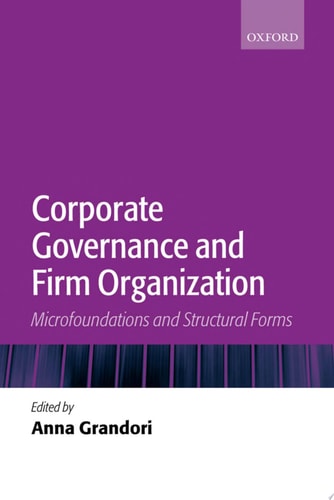
Corporate Governance and Firm Organization: Microfoundations and Structural Forms
0
0
As an Amazon Associate and affiliate partner, Menrva Books earns from qualifying purchases. Learn more
Author Description
Recent scandals involving large firms, in the US and elsewhere, have intensified discussion regarding the role and conduct of the corporation. The contributors to this book argue that much of this debate has taken too narrow a view of the issue of corporate governance, and question some of the key assumptions of economic models.Drawing on insights from a variety of fields, including management studies, organization studies, economics and finance, political science, sociology, psychology, and legal studies, the contributors argue that these models fail to take account of the varied and complex behaviour of actors within the corporation. Instead the cognitive and motivational foundations of governance problems and possible solutions are re-worked to produce a broader conception of governance, and a new range of forms that this can take. The book argues that no one of these forms is the 'solution' to the corporate governance problem.The book contains chapters from leading international management scholars, including: Masahiko Aoki, Margaret Blair, John Child, Alvaro Cuervo-Cazurra, Bruno Frey, Anna Grandori, Joseph Lampel, Ryon Lancaster, William Lazonick, Siegwart Lindenberg, Patrick Moreton, Margit Osterloh, Michael Piore, Andrea Prencipe, Suzana Rodrigues, Mark Roe, Giuseppe Soda, Steen Thomsen, Brian Uzzi, Paul Windolf, and Todd Zenger.Corporate Governance and Firm Organization provides an important contribution to the corporate governance debate, and will be essential reading for academics and graduate students of corporate governance, business and management, economics, finance, sociology, and law; Consultants, professionals, and policy-makers working in the area of corporate governance.
Menrva's Summary
THE THESIS
This book investigates the limitations of traditional economic models in explaining corporate governance and proposes a multi-disciplinary framework to better understand the internal microfoundations of firm organization. Anna Grandori, a prominent scholar in management and organization studies, curates a collection of essays from leading international experts across fields such as economics, law, sociology, and psychology. The contributors argue that current debates are overly narrow and fail to account for the complex cognitive and motivational behaviors of actors within the corporation. By integrating diverse academic perspectives, the text seeks to broaden the conception of governance beyond singular solutions, offering a new range of structural forms for firm organization.
THE SCOPE MAP
What You Will Find
- Analysis of the cognitive and motivational microfoundations of corporate governance.
- A multi-disciplinary critique of standard economic models and assumptions.
- Examination of various structural forms of firm organization beyond traditional hierarchies.
- Theoretical contributions from a diverse panel of international scholars in management, finance, and law.
THE AUTHORITY PERSPECTIVE
Experts recognize this volume as a significant interdisciplinary contribution to the study of corporate governance and organizational design. Readers frequently note the academic density of the prose, making it a valuable resource for graduate students, researchers, and policy-makers seeking a nuanced understanding of firm behavior.
Page Count:
418
Publication Date:
2004-11-11
Publisher:
Oxford University Press
ISBN-10:
0199269769
ISBN-13:
9780199269761
Economics
Business
Organizational Theory
Sociology
Management
Finance
Corporate governance
Community Tags
Similar Books