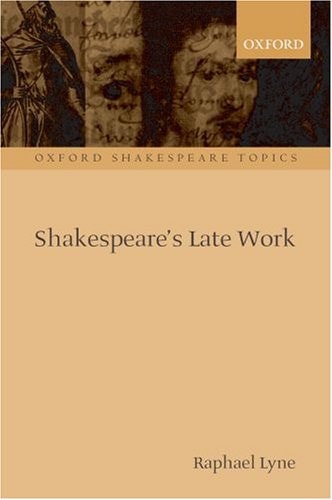
Shakespeare's Late Work
0
0
As an Amazon Associate and affiliate partner, Menrva Books earns from qualifying purchases. Learn more
Author Description
Product Description Shakespeare's Late Work is a detailed reading of the plays written at the end of Shakespeare's career, centering on Pericles, Cymbeline, The Winter's Tale, and The Tempest. Unlike many previous studies it considers all the late work, including Henry VIII, The Two Noble Kinsmen, the revisedFolio version of King Lear, and even what can be ascertained about the lost Cardenio. From this broadened canon emerge signs of a distinct identity for the late work. Lyne explores how Shakespeare sets great store in grand principles--faith in God, love of family, reverence for monarchs, and beliefin theatrical representations of truth. However, there is also a ubiquitous and structuring irony whereby such principles are questioned and doubted. Audiences and readers are left with a difficult but empowering decision whether to believe, or to question, or to accommodate both faith andskepticism. Alongside this interest in the new and characteristically "late" qualities of this phase in Shakespeare's career, Shakespeare's Late Work puts it in a wider cultural context. A chapter on the collaborations and broader dramatic relationships with John Fletcher and Thomas Middletonilluminates how Shakespeare's canon interacts with other writing of its time. A chapter on how the late work revisits and reconsiders themes from earlier plays shows that continuity needs to be remembered alongside novelty. Overall this is an introduction to the key works of this period whichadvances a new reading of them. They emerge as fascinating and dazzling explorations of their potential and their limitations. About the Author Raphael Lyne is a University Lecturer in the Faculty of English, and a Fellow of New Hall at the University of Cambridge.
Menrva's Summary
THE THESIS
This book investigates the distinct thematic and stylistic identity of William Shakespeare's final dramatic works, questioning how these plays balance grand moral principles with pervasive skepticism. Raphael Lyne, a lecturer at the University of Cambridge, utilizes a comprehensive analysis of the late canon to argue that these plays function as complex explorations of both faith and doubt. By examining the interplay between Shakespeare's established themes and his late-career innovations, Lyne provides a framework for understanding the intellectual landscape of the playwright's final years.
THE SCOPE MAP
What You Will Find
- Detailed analysis of Pericles, Cymbeline, The Winter's Tale, The Tempest, Henry VIII, and The Two Noble Kinsmen.
- Examination of the revised Folio version of King Lear and the lost play Cardenio.
- Investigation into collaborative relationships with John Fletcher and Thomas Middleton.
- Comparative study of how late works revisit and recontextualize themes from earlier plays.
THE AUTHORITY PERSPECTIVE
Scholars and students of early modern drama frequently cite this text as a valuable introduction to the complexities of Shakespeare's final period. The prose is noted for its academic rigor while remaining accessible to those seeking a nuanced understanding of the playwright's evolving dramatic philosophy.
Page Count:
184
Publication Date:
2007-05-03
Publisher:
Oxford University Press
ISBN-10:
0199265941
ISBN-13:
9780199265947
Drama
History
Literary Criticism
Academic
English
English & College Success
Shakespeare
Community Tags
Other Editions(3)

Similar Books


Reader Comments
Share Your Thoughts
No comments yet. Be the first to share your thoughts!