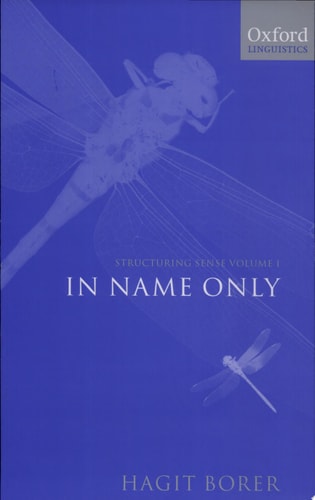
Structuring Sense: Volume I: In Name Only
0
0
As an Amazon Associate and affiliate partner, Menrva Books earns from qualifying purchases. Learn more
Author Description
Structuring Sense explores the difference between words however defined and structures however constructed. It sets out to demonstrate over three volumes, of which this is the first, that the explanation of linguistic competence should be shifted from lexical entry to syntactic structure, from memory of words to manipulation of rules. Its reformulation of how grammar and lexicon interact has profound implications for linguistic, philosophical, and psychological theories about human mind and language.Hagit Borer departs from both constructional approaches to syntax and the long generative tradition that uses the word as the nucleus around which the syntax grows. She argues that the hierarchical, abstract structures of language are universal, not language specific, and that language variation emerges from the morphological and phonological properties of inflectional material.In Name Only applies this radical approach to nominal structure. Integrating research in syntax, semantics, and morphology, the author argues that nominal structure is based on the syntactic realization of semantic notions such as classifier, quantity, and reference. In the process she seeks to do away with lexical ambiguity and type-shifting. Among the topics she considers are the interpretation of proper names, the mass-count distinction, the weak-strong interpretation of quantifiers, partitive and measure phrases, and the structural representation of the definite article. In the process she explores inter-language variation through the properties of the morpho-phonological system. The languages discussed include English, Chinese, Italian, and Hebrew.
Menrva's Summary
THE THESIS
This volume investigates whether linguistic competence is better explained by lexical entries or by the hierarchical manipulation of syntactic structures. Hagit Borer, a prominent linguist, challenges the traditional generative view that centers syntax around the word. She proposes that abstract syntactic structures are universal, and that observed language variation arises from the morphological and phonological properties of inflectional material rather than from the lexicon itself.
THE SCOPE MAP
What You Will Find
- Analysis of nominal structures including classifier, quantity, and reference.
- Examination of the mass-count distinction and the interpretation of proper names.
- Comparative linguistic data drawn from English, Chinese, Italian, and Hebrew.
- A theoretical framework that seeks to eliminate lexical ambiguity and type-shifting.
THE AUTHORITY PERSPECTIVE
Experts recognize this work as a significant contribution to the field of generative linguistics, particularly for its radical departure from traditional lexicalist approaches. Readers frequently note the high level of academic density and the rigorous, technical nature of the arguments presented throughout the text.
Page Count:
324
Publication Date:
2005-03-24
Publisher:
Oxford University Press
ISBN-10:
0199263892
ISBN-13:
9780199263899
Syntax
Academic
Semantics
Reference
Linguistics
Morphology
Community Tags
Similar Books