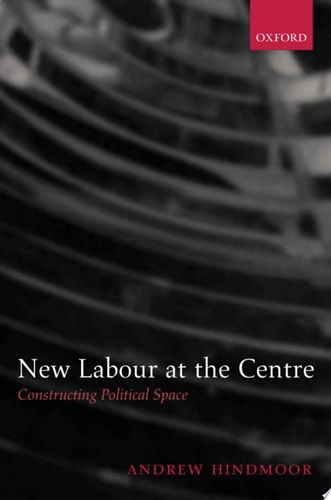
New Labour at the Centre: Constructing Political Space
0
0
As an Amazon Associate and affiliate partner, Menrva Books earns from qualifying purchases. Learn more
Author Description
Taking as its starting-point Anthony Downs' seminal work, An Economic Theory of Democracy, this book draws upon insights generated within economics, political psychology, and the study of rhetoric to examine the way in which New Labour achieved and maintained its electoral hegemony from 1994.Journalists and politicians routinely attribute New Labour's electoral success to its occupation of the 'centre-ground'. This book is interested in the question of how New Labour moved to the right and towards the centre. The obvious answer to this question is that New Labour moved by changing its policies. Against this, the book contends that changes in policy cannot in themselves constitute a complete explanation of changes in spatial position. They cannot do so because there is no pre-given and fixed relationship between policies and position such that the rejection of one policy and the adoption of another moves a party from one position to another. Policies are not immutably left-wing, right-wing, or centrist and so, given that the position a party is thought to occupy is a function of the policies to which it is committed, parties are not immutably left-wing, right-wing, or centrist either. The relationship between policy and position and thereby between parties and position is constructed and is in part constructed by parties themselves. New Labour did not simply move to the centre. It had to persuade the media, voters, and other parties that it had moved to the centre. New Labour achieved and maintained its electoral hegemony not simply by changing one set of policies for another. It achieved and maintained its hegemony by successfully constructing its policies as centrist.
Menrva's Summary
THE THESIS
This book investigates how the New Labour party successfully constructed and maintained its political position in the centre-ground of British politics. Andrew Hindmoor, a scholar in political science, utilizes a framework derived from Anthony Downs' economic theory of democracy, supplemented by insights from political psychology and rhetorical studies. He argues that political positioning is not a static result of policy changes, but rather a dynamic process of construction and persuasion directed toward voters, the media, and political opponents.
THE SCOPE MAP
What You Will Find
- An analysis of the electoral hegemony of New Labour starting from 1994.
- A theoretical framework challenging the assumption that policy changes automatically dictate political positioning.
- An examination of the role of rhetoric and perception in defining political space.
- Case studies and theoretical applications of political psychology to party strategy.
THE AUTHORITY PERSPECTIVE
Experts recognize this work as a significant contribution to the study of British political strategy and the mechanics of party positioning. Readers frequently note the academic density of the prose, which provides a rigorous analytical approach to understanding how political narratives are manufactured.
Page Count:
232
Publication Date:
2005-01-27
Publisher:
Oxford University Press
ISBN-10:
0199273146
ISBN-13:
9780199273140
Politics
British Politics
Political History
Political Theory
Community Tags
Similar Books