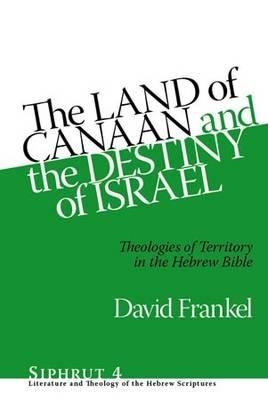
The Land of Canaan and the Destiny of Israel
0
0
As an Amazon Associate and affiliate partner, Menrva Books earns from qualifying purchases. Learn more
Author Description
What place does the land of Canaan play in the biblical conception of {u2018}Israel{u2019}? To what extent does the religion promoted by the Hebrew Bible require that Israel live its communal life in the national homeland? And how does life in the land compare in importance with other elements presented as belonging to Israel{u2019}s ultimate density, such as, for example, adherence to the law? To what extent must the people of Israel take hold of and settle in the {u2018}entire land of Canaan{u2019} for them to fulfill their destiny? Might the land be shared with other peoples, or must non-Israelites be expelled and subjugated, or at least kept at a safe and isolated distance? Frankel asks these questions and others of the Hebrew Bible as a whole and of the biblical texts individually. He shows that all of these questions were addressed by various biblical authors and that diverse and even opposing answers were given to them. These issues are not completely new.^ Many of them have been addressed in recent times by various scholars and theologians who have taken a renewed interest in the {u2018}territorial dimension{u2019} of the Hebrew Bible. However, works of a predominately theological or sociological orientation often suffer from a tendency to read the biblical texts holistically and to gloss over textual snags and inconsistencies. For Frankel, the snags and inconsistencies in the texts are of central importance. They allow him carefully to reconstruct the process of growth of the texts in question and to reveal both their original forms and their final transformation of several biblical texts lie earlier versions that often displayed remarkably open and inclusive conceptions of the relationship between the people of Israel and the land of Canaan.^ Diachronic analysis of the biblical text is thus an essential component in this book{u2019}s attempt to retrieve something of the heated theological dynamic that animated the work of authors and editors whose effor
Menrva's Summary
THE THESIS
The Land of Canaan and the Destiny of Israel investigates the pivotal role of the land of Canaan within the biblical conception of Israel and its religious identity. It probes the extent to which the Hebrew Bible mandates that Israel's communal life be centered in its national homeland, and how this territorial imperative compares to other elements of Israel's ultimate destiny, such as adherence to the law. The book further explores the biblical discourse on whether the entirety of Canaan must be settled by Israel to fulfill its destiny, and the varied perspectives on coexisting with, expelling, or subjugating other peoples within the land.
THE SCOPE MAP
- Analysis of the biblical conception of the land of Canaan and its significance for Israel's identity.
- Examination of the religious requirement for Israel to live in its national homeland.
- Comparison of the importance of land possession versus other aspects of Israel's destiny, like adherence to the law.
- Exploration of the biblical texts' diverse answers regarding the settlement of the entire land of Canaan.
- Discussion of varying biblical perspectives on sharing the land with other peoples, expulsion, subjugation, or isolation.
- Reconstruction of the growth and transformation of biblical texts through diachronic analysis.
- Identification of earlier versions of biblical texts that presented more inclusive conceptions of Israel's relationship with Canaan.
THE AUTHORITY PERSPECTIVE
This book is regarded as a significant scholarly contribution to the understanding of the territorial dimension of the Hebrew Bible. By focusing on textual inconsistencies and employing diachronic analysis, the author reconstructs the evolution of biblical thought on Israel's relationship with the land of Canaan. The work is noted for its careful examination of diverse and sometimes opposing answers presented within the biblical texts themselves. It highlights how earlier versions of certain texts offered more open and inclusive views on the matter.
Page Count:
443
Publication Date:
2011-01-01
ISBN-10:
157506202X
ISBN-13:
9781575062020
History
Non-Fiction
Religion
Theology
Community Tags
Similar Books