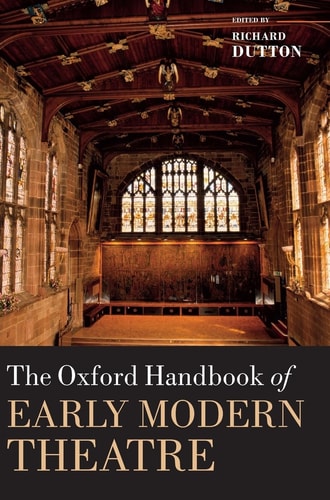
The Oxford Handbook of Early Modern Theatre
0
0
As an Amazon Associate and affiliate partner, Menrva Books earns from qualifying purchases. Learn more
Author Description
There was no single 'Elizabethan stage'. Early modern actors exploited various opportunities for patronage and profit between the 1570s and 1642, whether touring, or performing at inns, in country houses, in purpose-built theatres, at court, at the universities, or at the inns of court. This authoritative and comprehensive collection of new essays explores the social, political, and economic pressures under which the playing companies of Shakespeare and his contemporaries operated. It shows how they evolved over time to meet new challenges such as the opposition of City of London authorities, the possibility of permanent location in London, the re-emergence of boy companies c. 1600, and the great increase in court performance which began under James I. Essays also explore the practical everyday business of playing: acquiring scripts and playhouses, dramatic authorship, the contribution of financiers and entrepreneurs, rehearsing, lighting, music, props, styles of acting, boy actors, and the role of women in an 'all-male' world. A number of contributors address the methodologies of theatre history itself, questioning its philosophical premises and evaluating the nature of the evidence we have, such as that from stage directions in play-books or from the visual records. The collection as a whole offers a challenging account of the world of the players in Tudor-Stuart England, revising old assumptions and so inviting us to explore anew the plays which were written for them and which are their greatest living legacy.
Menrva's Summary
THE THESIS
This collection investigates the complex social, political, and economic structures that defined the early modern English theatre industry between 1570 and 1642. Edited by Richard Dutton, the volume compiles original essays from leading scholars to re-examine the operational realities of playing companies during the Tudor and Stuart eras. By analyzing the interplay between patronage, urban regulation, and performance logistics, the text challenges traditional historical narratives regarding the evolution of the Elizabethan and Jacobean stage.
THE SCOPE MAP
What You Will Find
- Analysis of the economic pressures and patronage systems influencing playing companies.
- Examination of performance venues ranging from inns and country houses to purpose-built London theatres.
- Methodological critiques of theatre history, including the interpretation of stage directions and visual evidence.
- Detailed accounts of production logistics, including script acquisition, rehearsal practices, and the role of boy companies.
THE AUTHORITY PERSPECTIVE
Experts identify this volume as a foundational reference for scholars and students of Renaissance drama. Readers frequently note the academic density of the prose, which provides a rigorous and comprehensive overview of the period's theatrical infrastructure.
Page Count:
624
Publication Date:
2009-08-01
Publisher:
Oxford University Press
ISBN-10:
0199287244
ISBN-13:
9780199287246
History
Shakespeare
Theater
Early Modern
Academic
Great Britain
Theatre