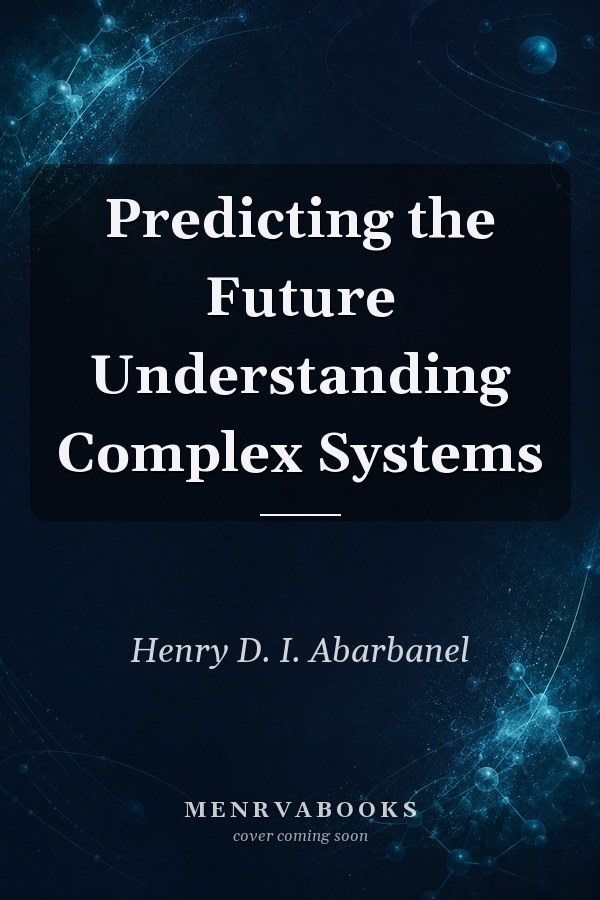
Predicting the Future: Understanding Complex Systems
0
0
As an Amazon Associate and affiliate partner, Menrva Books earns from qualifying purchases. Learn more
Author Description
Formulates long standing state and parameter estimation problems. Explores numerous examples drawn from a broad interdisciplinary collection of scholarly subjects. Proposes a universal approach with practical examples to bolster significant advances in solving the problems of model determination and parameter estimation. Predicting the Future: Completing Models of Observed Complex Systems provides a general framework for the discussion of model building and validation across a broad spectrum of disciplines. This is accomplished through the development of an exact path integral for use in transferring information from observations to a model of the observed system. Through many illustrative examples drawn from models in neuroscience, fluid dynamics, geosciences, and nonlinear electrical circuits, the concepts are exemplified in detail. Practical numerical methods for approximate evaluations of the path integral are explored, and their use in designing experiments and determining a model's consistency with observations is investigated. Using highly instructive examples, the problems of data assimilation and the means to treat them are clearly illustrated. This book will be useful for students and practitioners of physics, neuroscience, regulatory networks, meteorology and climate science, network dynamics, fluid dynamics, and other systematic investigations of complex systems -- Publisher's website.
Menrva's Summary
THE THESIS
This book proposes a universal approach to model determination and parameter estimation for complex systems by developing an exact path integral for transferring information from observations to a model. It draws upon numerous examples from diverse scholarly subjects, including neuroscience, fluid dynamics, geosciences, and nonlinear electrical circuits, to illustrate its concepts. The work explores practical numerical methods for approximate path integral evaluations and their application in experimental design and model validation. It also clearly demonstrates how to address data assimilation problems using instructive examples.
THE SCOPE MAP
- A general framework for model building and validation across various disciplines.
- Development of an exact path integral for information transfer from observations to models.
- Illustrative examples from neuroscience, fluid dynamics, geosciences, and nonlinear electrical circuits.
- Practical numerical methods for approximate path integral evaluations.
- Investigation into designing experiments and determining a model's consistency with observations.
- Clear illustration of data assimilation problems and their treatment.
THE AUTHORITY PERSPECTIVE
The book is presented as a valuable resource for students and practitioners across a wide array of scientific fields, including physics, neuroscience, meteorology, climate science, and fluid dynamics. Its approach aims to bolster advances in solving model determination and parameter estimation problems. The publisher's website highlights its utility for those engaged in systematic investigations of complex systems. The text provides a general framework and practical examples for understanding and validating models of observed complex systems.
Page Count:
238
Publication Date:
2013-01-01
ISBN-10:
1461472172
ISBN-13:
9781461472179
Science
Fluid dynamics
Neuroscience
Complex Systems
Community Tags
Similar Books