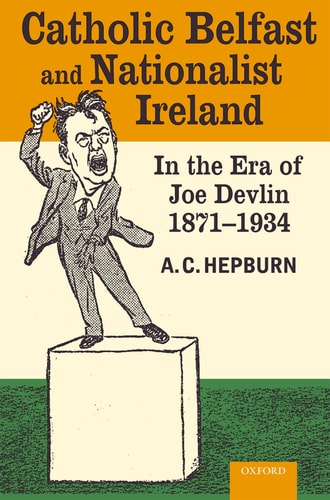
Catholic Belfast and Nationalist Ireland in the Era of Joe Devlin, 1871-1934
0
0
As an Amazon Associate and affiliate partner, Menrva Books earns from qualifying purchases. Learn more
Author Description
The Irish revolution of 1916-23 is generally regarded as a success. It was a disastrous failure, however, for the Catholic and nationalist minority in what became Northern Ireland. It resulted in partition, a discriminatory majoritarian regime and, more recently, a generation of renewed violence and a decade of political impasse. It is often suggested that the blame for this outcome rests not only on "perfidious Albion" and the "bigotry" of Ulster Unionism but also on the constitutional nationalist leaders, John Redmond, John Dillon and Joe Devlin. This book argues that, on the contrary, the era of violence provoked by Sinn Féin's 1918 general election victory was the primary cause of partition so far as actions on the nationalist side were concerned.Hepburn also suggests that the exclusively Catholic Ancient Order of Hibernians was in fact less sectarian than Sinn Féin, and that Devlin's practical contribution to the improvement of working-class conditions was more substantial than that of his republican socialist contemporaries. Too much Irish history has been written from the standpoint of the winners. This book, as well as detailing the life of an important but neglected individual in the context of a social history of Catholic Belfast, offers a general re-interpretation of Irish political history between the 1890s and the 1930s from the perspective of the losers.
Menrva's Summary
THE THESIS
This book investigates whether the political strategies of constitutional nationalist leaders, specifically Joe Devlin, were responsible for the partition of Ireland or if the rise of revolutionary violence was the primary catalyst. A.C. Hepburn, a scholar of Irish social history, utilizes archival records and political analysis to challenge the prevailing narrative that constitutional nationalists failed their constituents. He argues that the shift toward militant republicanism following the 1918 election was the decisive factor in the marginalization of the Catholic minority in Northern Ireland.
THE SCOPE MAP
What You Will Find
- A detailed examination of the political landscape in Belfast between 1871 and 1934.
- An analysis of the Ancient Order of Hibernians and its role in Catholic social life.
- A comparative study of constitutional nationalism versus the rise of Sinn Féin.
- A re-evaluation of the socio-economic contributions of Joe Devlin to the working class.
THE AUTHORITY PERSPECTIVE
Historians and scholars of Irish history recognize this work as a significant revisionist contribution that shifts the focus from the victors of the revolution to the marginalized minority in Northern Ireland. Readers frequently note the academic density of the prose and the author's meticulous use of primary sources to support his counter-narrative.
Page Count:
336
Publication Date:
2008-09-15
Publisher:
Oxford University Press
ISBN-10:
019929884X
ISBN-13:
9780199298846
Biography
History
Catholics_ireland
Political History
Northern Ireland
Politics & Government
Social History
Irish History
Nationalism ireland