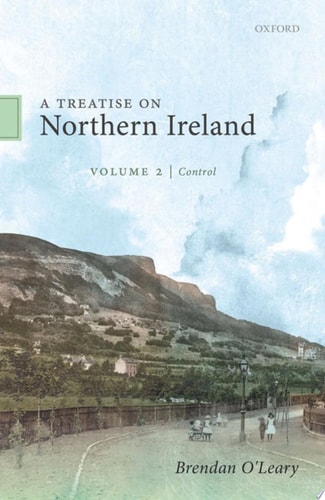
A Treatise On Northern Ireland: Volume II
0
0
As an Amazon Associate and affiliate partner, Menrva Books earns from qualifying purchases. Learn more
Author Description
This Landmark Synthesis Of Political Science And Historical Institutionalism Is A Detailed Study Of Antagonistic Ethnic Majoritarianism. Northern Ireland Was Coercively Created Through A Contested Partition In 1920. Subsequently Great Britain Compelled Sinn Féin's Leaders To Rescind The Declaration Of An Irish Republic, Remain Within The British Empire, And Grant The Belfast Parliament The Right To Secede. If It Did So, A Commission Would Consider Modifying The New Border. The Outcome, However, Was The Formation Of Two Insecure Regimes, North And South, Both Of Which Experienced Civil War, While The Boundary Commission Was Subverted. In The North A Control System Organized The New Majority Behind A Dominant Party That Won All Elections To The Belfast Parliament Until Its Abolition In 1972. The Ulster Unionist Party Successfully Disorganized Northern Nationalists And Catholics. Bolstered By The 'specials,' A Militia Created From The Ulster Volunteer Force, This System Displayed A Pathological Version Of The Westminster Model Of Democracy, Which May Reproduce One-party Dominance, And Enforce National, Ethnic, Religious, And Cultural Discrimination. How The Unionist Elite Improvised This Control Regime, And Why It Collapsed Under The Impact Of A Civil Rights Movement In The 1960s, Take Center-stage In This Second Volume Of A Treatise On Northern Ireland. The North's Trajectory Is Paired And Compared With The Irish Free State's Incremental Decolonization And Restoration Of A Republic. Irish State-building, However, Took Place At The Expense Of The Limited Prospect Of Persuading Ulster Protestants That Irish Reunification Was In Their Interests, Or Consistent With Their Identities. Northern Ireland Was Placed Under British Direct Rule In 1972 While Counter-insurgency Practices Applied Elsewhere In Its Diminishing Empire Were Deployed From 1969 With Disastrous Consequences. On January 1 1973, However, The Uk And Ireland Joined The Then European Economic Community.
Menrva's Summary
THE THESIS
This volume investigates the structural mechanisms of antagonistic ethnic majoritarianism and the subsequent collapse of the Northern Irish control regime. Brendan O'Leary, a prominent political scientist, utilizes historical institutionalism to analyze the partition of Ireland and the political dynamics of the Belfast Parliament. The work argues that the Ulster Unionist Party established a system of one-party dominance that systematically marginalized the nationalist population, ultimately leading to the state's instability and the eventual imposition of direct rule.
THE SCOPE MAP
What You Will Find
- Analysis of the 1920 partition and the failure of the Boundary Commission.
- Examination of the Ulster Unionist Party's control mechanisms and the role of the 'Specials' militia.
- Comparative study of Northern Ireland's trajectory alongside the Irish Free State's decolonization process.
- Assessment of the impact of the 1960s civil rights movement on the collapse of the Stormont regime.
Scope Limits
- The analysis focuses primarily on the period leading up to 1972 and the early years of direct rule.
- The text does not provide an exhaustive account of the later stages of the Troubles or the Good Friday Agreement.
THE AUTHORITY PERSPECTIVE
Experts recognize this work as a rigorous application of political science frameworks to the history of Northern Ireland. Readers frequently note the academic density of the prose, which provides a comprehensive and detailed examination of institutional power structures.
Page Count:
352
Publication Date:
2019-01-01
Publisher:
Oxford University Press
ISBN-10:
019256630X
ISBN-13:
9780192566300
History
Irish History
Political History
Northern Ireland
Government
Community Tags
Similar Books