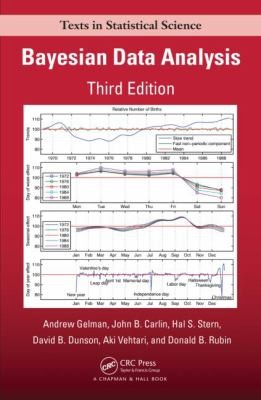
Bayesian Data Analysis Third Edition
0
0
As an Amazon Associate and affiliate partner, Menrva Books earns from qualifying purchases. Learn more
Author Description
Preface This book is intended to have three roles and to serve three associated audiences: an introductory text on Bayesian inference starting from first principles, a graduate text on effective current approaches to Bayesian modeling and computation in statistics and related fields, and a handbook of Bayesian methods in applied statistics for general users of and researchers in applied statistics. Although introductory in its early sections, the book is definitely not elementary in the sense of a first text in statistics. The mathematics used in our book is basic probability and statistics, elementary calculus, and linear algebra. A review of probability notation is given in Chapter 1 along with a more detailed list of topics assumed to have been studied. The practical orientation of the book means that the reader's previous experience in probability, statistics, and linear algebra should ideally have included strong computational components. To write an introductory text alone would leave many readers with only a taste of the conceptual elements but no guidance for venturing into genuine practical applications, beyond those where Bayesian methods agree essentially with standard non-Bayesian analyses. On the other hand, we feel it would be a mistake to present the advanced methods without first introducing the basic concepts from our data-analytic perspective. Furthermore, due to the nature of applied statistics, a text on current Bayesian methodology would be incomplete without a variety of worked examples drawn from real applications. To avoid cluttering the main narrative, there are bibliographic notes at the end of each chapter and references at the end of the book
Menrva's Summary
THE THESIS
This book serves as an introductory text on Bayesian inference, a graduate text on current Bayesian modeling and computation, and a handbook for applied statistics users. The author, Andrew Gelman, assumes basic knowledge of probability, statistics, calculus, and linear algebra, with a strong emphasis on computational components. The text integrates conceptual elements with practical applications, drawing from real-world examples to illustrate current Bayesian methodology.
THE SCOPE MAP
- Introduction to Bayesian inference from first principles.
- Effective current approaches to Bayesian modeling and computation.
- Handbook of Bayesian methods in applied statistics.
- Review of probability notation and assumed prior knowledge in Chapter 1.
- Emphasis on computational components in previous statistical experience.
- Integration of conceptual elements with practical applications.
- Worked examples drawn from real applications.
- Bibliographic notes and references at the end of each chapter and the book.
THE AUTHORITY PERSPECTIVE
As a foundational text in Bayesian data analysis, this book is recognized for its comprehensive approach, catering to both introductory and advanced learners. Its practical orientation and inclusion of real-world examples make it a valuable resource for researchers and practitioners in statistics and related fields. The structured progression from basic concepts to advanced computational methods ensures a thorough understanding of Bayesian principles.
Page Count:
675
Publication Date:
2013-01-01
ISBN-10:
1439840954
ISBN-13:
9781439840955
Non-Fiction
Science
Data Analysis
Bayesian Inference
Statistics
Computational statistics
Community Tags
Similar Books