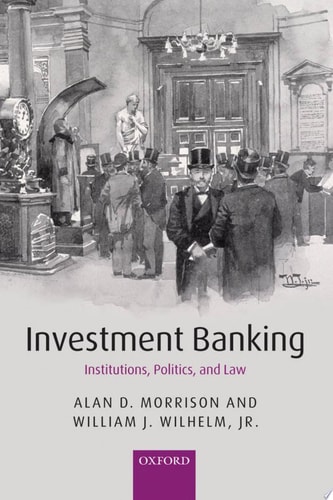
Investment Banking: Institutions, Politics, and Law
0
0
As an Amazon Associate and affiliate partner, Menrva Books earns from qualifying purchases. Learn more
Author Description
Investment Banking: Institutions, Politics, and Law provides an economic rationale for the dominant role of investment banks in the capital markets, and uses it to explain both the historical evolution of the investment banking industry and also recent changes to its organization. Although investment decisions rely upon price-relevant information, it is impossible to establish property rights over it and hence it is very hard to coordinate its exchange. The authors argue that investment banks help to resolve this problem by managing "information marketplaces," within which extra-legal institutions support the production and dissemination of information that is important to investors. Reputations and relationships are more important in fulfilling this role than financial capital.The authors substantiate their theory with reference to the industry's evolution during the last three centuries. They show how investment banking networks were formed, and identify the informal contracts that they supported. This historical development points to tensions between the relational contracting of investment banks and the regulatory impulses of the State, thus providing some explanation for the periodic large-scale State intervention in the operation of capital markets. Their theory also provides a technological explanation for the massive restructuring of the capital markets in recent decades, which the authors argue can be used to think about the likely future direction of the investment banking industry.
Menrva's Summary
THE THESIS
This book investigates the economic rationale behind the dominance of investment banks in capital markets by analyzing the intersection of institutional structures, political pressures, and legal frameworks. Authors Alan D. Morrison and William J. Wilhelm Jr. utilize a framework centered on the concept of information marketplaces to explain how investment banks facilitate the exchange of price-relevant information. By examining the industry's evolution over three centuries, the authors argue that reputation and relational contracting are more critical to banking success than financial capital alone. This analysis provides a basis for understanding the recurring tensions between private market networks and state regulatory interventions.
THE SCOPE MAP
What You Will Find
- A historical analysis of investment banking evolution spanning the last three centuries.
- A theoretical framework explaining the management of information marketplaces.
- Examination of the conflict between relational contracting and state regulatory impulses.
- Technological and structural explanations for recent changes in global capital markets.
THE AUTHORITY PERSPECTIVE
Experts and academics frequently cite this work as a foundational text for understanding the institutional mechanics of investment banking. Readers often note the academic density of the prose, which provides a rigorous economic perspective on the industry's historical and political development.
Page Count:
356
Publication Date:
2007-03-15
Publisher:
Oxford University Press
ISBN-10:
019929657X
ISBN-13:
9780199296576
Economics
Law
Business History
Finance
Community Tags
Similar Books