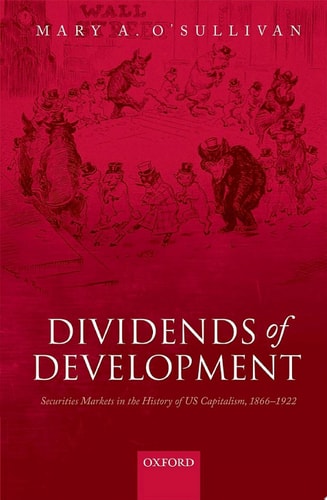
Dividends of Development: Securities Markets in the History of U.S. Capitalism, 1866-1922
0
0
As an Amazon Associate and affiliate partner, Menrva Books earns from qualifying purchases. Learn more
Author Description
The unprecedented importance of finance in our societies, as well as its central role in provoking economic crises, has generated an enormous interest in understanding the historical origins and evolution of modern financial systems. Today the U.S. economy is seen as an archetype of a capitalist system in which securities markets play a central role. Moreover, these markets have had a high profile in some of the most dramatic moments in U.S. history, often in the context of crises. Dividends of Development: Securities Markets in the History of U.S. Capitalism, 1865-1922, explains how U.S. securities markets became central to the institutional fabric of U.S. capitalism. After the Civil War, these markets had a narrowly circumscribed relationship to the country's real economy, being largely dominated by railroad securities. Moreover, their role in the U.S. financial system was of limited significance given the relatively modest resources that financial institutions committed to investment in, and lending on, corporate securities. That situation was to undergo fundamental change from the Civil War through the end of World War 1 but the development of U.S. securities markets did not occur as a result of a smooth, or even, linear process. Instead, the book shows that the transformation of U.S. securities markets occurred through a process that was volatile and time-consuming, unscripted by powerful actors, and driven, above all else, by the dramatic but unstable character of the nation's economic development. These claims about the trajectory, the operation, and the underlying dynamics of the development of U.S. securities markets are brought together in a novel synthesis that portrays the historical evolution of securities markets in the United States as the "dividends" of the country's distinctive trajectory of economic development.
Menrva's Summary
THE THESIS
How did U.S. securities markets evolve from a niche component of the post-Civil War economy into the central pillar of modern American capitalism? Mary A. O'Sullivan, a professor of economic history, utilizes extensive archival research and historical economic data to argue that this transformation was not a linear progression but a volatile, unscripted process. She posits that the growth of these markets was fundamentally tied to the unstable and dramatic trajectory of the nation's broader economic development during the late 19th and early 20th centuries.
THE SCOPE MAP
What You Will Find
- Analysis of the transition from railroad-dominated securities to a broader corporate market.
- Examination of the institutional changes in U.S. financial systems between 1866 and 1922.
- Synthesis of economic data regarding investment patterns and corporate lending practices.
Scope Limits
- The study does not extend beyond the conclusion of World War I.
- The text focuses primarily on institutional and systemic development rather than individual biographical accounts of financiers.
THE AUTHORITY PERSPECTIVE
Scholars and economic historians frequently cite this work as a rigorous, data-driven examination of the structural foundations of U.S. financial markets. Readers often note the academic density of the prose, which serves as a foundational text for those studying the intersection of industrial growth and financial regulation.
Page Count:
402
Publication Date:
2016-01-01
Publisher:
OUP Oxford
ISBN-10:
0191092533
ISBN-13:
9780191092534
Economics
History
Capitalism
United States
Business History
Economics history
Finance
Community Tags
Similar Books