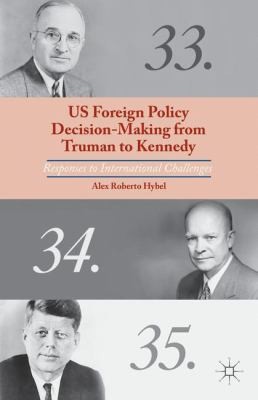
US Foreign Policy DecisionMaking from Truman to Kennedy
0
0
As an Amazon Associate and affiliate partner, Menrva Books earns from qualifying purchases. Learn more
Author Description
The administrations of Presidents Truman, Eisenhower, and Kennedy faced critical international challenges – including, most notably, using nuclear weapons against Japan, intervening militarily in Korea, toppling an emerging regime in Guatemala, restraining the actions of US allies during the Suez Canal Crisis, overthrowing Castro's Cuban regime, and forcing the USSR to remove nuclear missiles from Cuban soil. In this meticulously documented book, Alex Roberto Hybel tests the extent to which today's most important foreign policy decision-making models can explain the actions of the principal figures responsible for addressing each crisis. The book carefully analyses each president's cognitive system, the advisory structure each leader set up, and the pervading mindsets of Washington's insiders from each period. By evaluating the quality of each president's foreign policy decision-making process, readers will become familiar with core foreign policy decisions, how they were formulated, and the types of cognitive impediments that in certain instances undermined the quality of the decision-making process. --Provided by publisher.
Menrva's Summary
THE THESIS
This book investigates the effectiveness of modern foreign policy decision-making models in explaining critical international challenges faced by US presidents from Truman to Kennedy. Alex Roberto Hybel analyzes the cognitive systems, advisory structures, and prevailing mindsets of presidents Truman, Eisenhower, and Kennedy, as well as their Washington insiders, to understand their responses to crises such as the use of nuclear weapons, the Korean War, the Suez Canal Crisis, and the Cuban Missile Crisis. The book evaluates the quality of their foreign policy decision-making processes, highlighting cognitive impediments that sometimes undermined their effectiveness.
THE SCOPE MAP
- Analysis of foreign policy decision-making models applied to presidential administrations from Truman to Kennedy.
- Detailed examination of the cognitive systems and advisory structures of Presidents Truman, Eisenhower, and Kennedy.
- Exploration of the pervading mindsets of Washington's insiders during key Cold War periods.
- Case studies of critical international challenges including nuclear weapon use, Korean intervention, Suez Canal Crisis, and Cuban Missile Crisis.
- Evaluation of the quality of foreign policy decision-making and identification of cognitive impediments.
THE AUTHORITY PERSPECTIVE
The book meticulously documents its analysis, offering readers a thorough understanding of core foreign policy decisions made during a pivotal era. By evaluating the quality of each president's decision-making process, the work aims to familiarize readers with how these critical choices were formulated and the factors that influenced them. The author's focus on cognitive systems and advisory structures provides a framework for understanding the complexities of presidential foreign policy.
Page Count:
249
Publication Date:
2014-01-01
ISBN-10:
113729485X
ISBN-13:
9781137294852
Non-Fiction
Politics
History
International relations
Community Tags
Similar Books