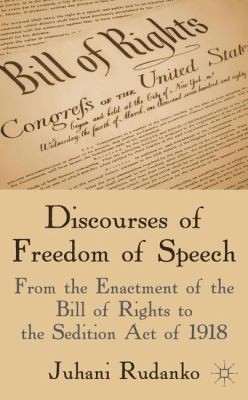
Discourses of Freedom of Speech
0
0
As an Amazon Associate and affiliate partner, Menrva Books earns from qualifying purchases. Learn more
Author Description
This book is for those interested in freedom of speech. Today the American Bill of Rights, with its famous First Amendment, is generally taken for granted, but when James Madison proposed a Bill of Rights in 1789, the reaction among his colleagues in the first Congress was hostile. The book examines how Madison was able to prevail in spite of such opposition. It also focuses on discourses connected to the Sedition Act of 1798, which represented a serious threat to freedom of speech and the first Amendment. The author sheds fresh light on key Congressional debates on the Bill of Rights and the Sedition Act by developing and applying an approach to fallacy theory that is suitable to the study of political discourse. He further focuses on criticism of the Madison administration in Federalist newspapers during the War of 1812, arguing that Madison's toleration of such criticism was important in shaping a tradition of free expression in the United States. Efforts to suppress free expression during the Wilson administration represented a serious challenge to this tradition, and the author goes on to employ fallacy theory in examining Congressional discourses for and against Wilson's policy of repression
Menrva's Summary
THE THESIS
The book investigates the historical development and defense of freedom of speech in the United States, particularly focusing on key legislative and political moments. It examines the initial resistance to the Bill of Rights, the challenges posed by the Sedition Act of 1798, and the role of criticism during the War of 1812 in shaping free expression traditions. The author applies fallacy theory to analyze political discourse, offering new perspectives on Congressional debates and the administrations of James Madison and Woodrow Wilson.
THE SCOPE MAP
- Analysis of James Madison's efforts to establish the Bill of Rights against congressional opposition.
- Examination of the Sedition Act of 1798 and its impact on freedom of speech.
- Application of fallacy theory to analyze political discourse in Congressional debates.
- Exploration of criticism directed at the Madison administration in Federalist newspapers during the War of 1812.
- Discussion of the Wilson administration's efforts to suppress free expression and their challenge to established traditions.
- Comparative analysis of free speech challenges across different historical periods in the U.S.
THE AUTHORITY PERSPECTIVE
The book offers a detailed historical analysis of freedom of speech in the United States, employing a specific theoretical framework to examine key legislative and political moments. Its approach, utilizing fallacy theory to dissect political discourse, provides a unique lens through which to understand historical debates surrounding free expression. The work is likely to appeal to scholars and students of American history, political science, and legal studies interested in the evolution of First Amendment rights. The author's focus on specific administrations and legislative acts suggests a rigorous and evidence-based examination of the subject.
Page Count:
201
Publication Date:
2012-01-01
ISBN-10:
1137030593
ISBN-13:
9781137030597
Politics
Non-Fiction
Science
History
Art
Law
Rhetoric
Community Tags
Similar Books