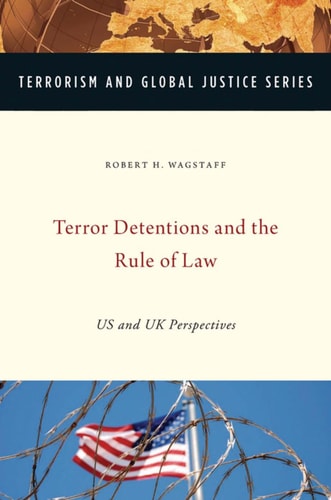
Terror Detentions and the Rule of Law: US and UK Perspectives
0
0
As an Amazon Associate and affiliate partner, Menrva Books earns from qualifying purchases. Learn more
Author Description
After the 9/11 terrorist attacks, the United States and the United Kingdom detained suspected terrorists in a manner incompatible with the due process, fair trial, and equality requirements of the Rule of Law. The legality of the detentions was challenged and found wanting by the highest courts in the US and UK. The US courts approached these questions as matters within the law of war, whereas the UK courts examined them within a human rights criminal law context.In Terror Detentions and the Rule of Law: US and UK Perspectives, Dr. Robert H. Wagstaff documents President George W. Bush's and Prime Minister Tony Blair's responses to 9/11, alleging that they failed to protect the human rights of individuals suspected of terrorist activity. The analytical focus is on the four US Supreme Court decisions involving detentions in Guantanamo Bay and four House of Lords decisions involving detentions that began in the Belmarsh Prison. These decisions are analyzed within the contexts of history, criminal law, constitutional law, human rights and international law, and various jurisprudential perspectives. In this book Dr. Wagstaff argues that time-tested criminal law is the normatively correct and most effective means for dealing with suspected terrorists. He also suggests that preventive, indefinite detention of terrorist suspects upon suspicion of wrongdoing contravenes the domestic and international Rule of Law, treaties and customary international law. As such, new legal paradigms for addressing terrorism are shown to be normatively invalid, illegal, unconstitutional, counter-productive, and in conflict with the Rule of Law.
Menrva's Summary
THE THESIS
This book investigates whether the post-9/11 detention policies of the United States and the United Kingdom are compatible with established principles of the Rule of Law. Dr. Robert H. Wagstaff, a legal scholar, evaluates the executive responses of the Bush and Blair administrations against the backdrop of constitutional and international legal standards. By contrasting the US approach, which utilized the law of war, with the UK approach, which relied on human rights and criminal law frameworks, the author argues that preventive, indefinite detention undermines both domestic and international legal norms. The text posits that traditional criminal law remains the most effective and normatively sound mechanism for addressing terrorist threats.
THE SCOPE MAP
What You Will Find
- Comparative analysis of four US Supreme Court rulings on Guantanamo Bay and four House of Lords decisions regarding Belmarsh Prison.
- Examination of the intersection between constitutional law, international treaties, and customary international law.
- Evaluation of executive branch responses to terrorism in the US and UK post-2001.
- Argumentative framework advocating for the primacy of established criminal law over new, preventive detention paradigms.
THE AUTHORITY PERSPECTIVE
Legal scholars and practitioners identify this work as a critical comparative study of post-9/11 judicial interventions in executive power. Readers frequently note the academic density of the prose, which provides a rigorous examination of the tension between national security imperatives and fundamental human rights.
Page Count:
400
Publication Date:
2013-12-17
Publisher:
Oxford University Press
ISBN-10:
0199301557
ISBN-13:
9780199301553
United States
Human rights
Constitutional Law
Law
International Law
Terrorism
Great Britain
Rule Of Law
Community Tags
Similar Books