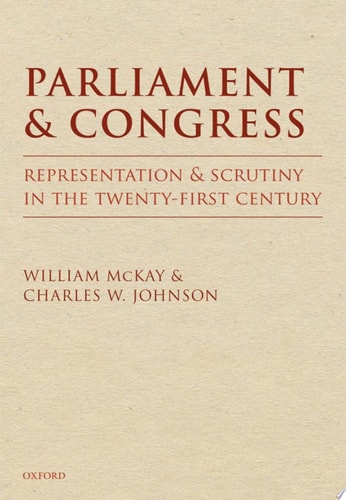
Parliament and Congress: Representation and Scrutiny in the Twenty-First Century
0
0
As an Amazon Associate and affiliate partner, Menrva Books earns from qualifying purchases. Learn more
Author Description
Parliament and Congress describes and compares the constitutional background and procedures of these two legislative bodies. Currently unsolved problems often have much in common, in vexed areas such as ethics requirements or how procedural rules permit minorities fair access to legislative time before majorities prevail. British successes include the enhanced authority and effectiveness of select committees and the acquisition of more debating time by the creation of a parallel Chamber. Unsolved problems at Westminster begin with the powers and status of the Lords, and go on through the search for more effective review of EU activities, adapting parliamentary scrutiny to more sophisticated government financial information, and making better use of legislative time without diminishing back-bench rights.The accelerated pace and extent of procedural changes in Congress is problematic. Constant pursuit of campaign funds, increased party exploitation of Members' ethical shortcomings, and partisan reapportionments, have diminished collegiality and compromise. Business is conducted with greater predictability, with fewer quorum calls, postponement and clustering of votes, and by utilization of ad hoc special orders, often in derogation of openness and minority rights in the House. Minority complaints have been frequent and occasionally extreme. Conversely constant filibuster threats in the Senate have enhanced minority party power there. An 'inverse ratio' between the greater complexity, importance, and urgency of pending legislation on the one hand, and diminution of deliberative capacity, fairness. and transparency on the other, has been repeatedly demonstrated, especially at the stage of final compromises between the Houses.
Menrva's Summary
THE THESIS
This work investigates the comparative efficacy of the British Parliament and the United States Congress in addressing the complex legislative and procedural challenges of the twenty-first century. The authors, Charles W. Johnson and William McKay, leverage their extensive experience within these legislative institutions to analyze how constitutional frameworks and internal rules shape modern governance. By examining the specific pressures of ethics, minority rights, and procedural transparency, they argue that both bodies face an inverse relationship between the urgency of modern policy demands and their capacity for fair, deliberative action.
THE SCOPE MAP
What You Will Find
- Comparative analysis of constitutional backgrounds and procedural rules in the UK and US.
- Examination of legislative ethics requirements and the impact of campaign finance on parliamentary and congressional conduct.
- Assessment of the effectiveness of select committees and the evolution of debating time in Westminster.
- Evaluation of the impact of filibuster threats, partisan reapportionment, and procedural clustering on legislative transparency.
THE AUTHORITY PERSPECTIVE
Experts recognize this text as a foundational comparative study for understanding the structural divergence of two major democratic legislatures. Readers frequently note the academic density of the prose, which provides a rigorous examination of how procedural shifts influence the democratic process in both nations.
Page Count:
596
Publication Date:
2010-07-22
Publisher:
Oxford University Press
ISBN-10:
0199273626
ISBN-13:
9780199273621
History
Comparative Politics
Legislative Studies
Government
United States
Great Britain
Constitutional Law
Representative government and representation
Community Tags
Similar Books