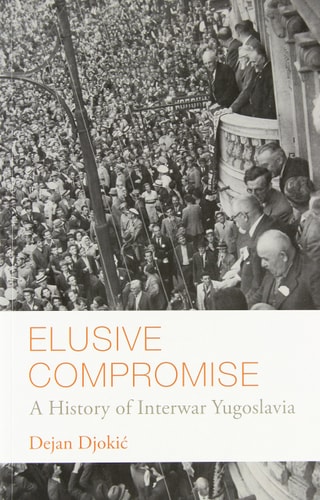
Elusive Compromise: A History of Interwar Yugoslavia
0
0
As an Amazon Associate and affiliate partner, Menrva Books earns from qualifying purchases. Learn more
Author Description
Product DescriptionBefore Tito's Yugoslavia, which disintegrated violently in the 1990s, there was another Yugoslav state. This book is about the original, interwar Yugoslavia (1918-41), and is based on the author's research in Croatian, Serbian, British and American archives and on extensive study of publishedsources. Unlike other scholars, Dejan Djoki argues that the period can be best understood through an analysis of attempts to reach a Serb-Croat compromise. Historians have long recognised the Croats' rejection of state centralism, but Djoki shows that many Serbs had also accepted federalism by themid-1930s. Djoki challenges the popular perception of the period as one of constant conflict between Serbs and non-Serbs and argues that the political mismanagement of the country paved the way for the radicalisation of the war years (1941-5) and the subsequent communist takeover. Although primarilya study of conflict management in a multinational state, the book provides an insight into the effects of politics on 'ordinary' people.Elusive Compromise places Yugoslavia in the context of a Europe-wide struggle between democracy and dictatorship, and contributes to an understanding of thedissolution of Yugoslavia and other multinational states.Review"Fascinating and compelling....an extremely important addition to the historiography of Yugoslavia."--V.P. Gagnon, author,The Myth of Ethnic War: Serbia and Croatia in the 1990s"Logical as the idea of a unified South Slav state seemed in the late nineteenth century, since such a state failed twice in the next century, catastrophically the second time, it is now easy to assume that the hope was flawed from the beginning and that the problem is in Serbian-Croatian relations.Key scholars have posited that failure was in the DNA of the first Yugoslavia--born of the First World War, destroyed by the Second--but Djokic argues that interwar Yugoslavia was not doomed by conflicting Croatian and Serbian national ideologies. Failure ca
Menrva's Summary
THE THESIS
Does the collapse of the first Yugoslav state represent an inevitable failure of national ideologies, or was it the result of specific political mismanagement? Dejan Djokic, a scholar specializing in Balkan history, utilizes extensive archival research from Croatia, Serbia, Britain, and the United States to challenge the prevailing narrative that the interwar period was defined solely by irreconcilable ethnic conflict. He argues that the state's dissolution was not preordained by inherent national divisions but was instead exacerbated by the failure to achieve a sustainable Serb-Croat political compromise.
THE SCOPE MAP
What You Will Find
- A detailed historical analysis of the interwar Yugoslav state from 1918 to 1941.
- An examination of the shift toward federalism among Serbian political factions during the mid-1930s.
- Primary source evidence derived from international and regional archives.
- A comparative framework placing Yugoslavia within the broader European struggle between democratic and authoritarian governance.
THE AUTHORITY PERSPECTIVE
Experts recognize this work as a significant contribution to the historiography of the Balkans, particularly for its nuanced re-evaluation of Serb-Croat relations. Scholars frequently highlight the book's ability to move beyond simplistic ethnic determinism to provide a rigorous analysis of political institutional failure.
Page Count:
320
Publication Date:
2007-01-01
Publisher:
Oxford University Press
ISBN-10:
0199326398
ISBN-13:
9780199326396
History
International relations
New Used & Rental Textbooks
Balkan History
European History
Europe
Community Tags
Similar Books