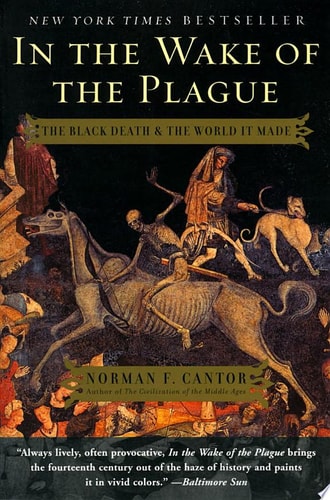
In the Wake of the Plague: The Black Death and the World It Made
0
0
As an Amazon Associate and affiliate partner, Menrva Books earns from qualifying purchases. Learn more
Author Description
Norman Cantor draws together the most recent scientific discoveries and historical research to pierce the mist and tell the story of the Black Death afresh, as a gripping, intimate narrative. In the Wake of the Plague presents a microcosmic view of the Plague in England (and on the continent), telling the stories of the men and women of the fourteenth century, from peasant to priest, and from merchant to king. We meet, among others, fifteen-year-old Princess Joan of England, on her way to Spain to marry a Castilian prince; Thomas of Birmingham, abbot of Halesowen, responsible for his abbey as a CEO is for his business in a desperate time; and the once-prominent landowner John le Strange, who sees the Black Death tear away his family's lands and then its very name as it washes, unchecked, over Europe in wave after wave.
Menrva's Summary
THE THESIS
This work investigates how the Black Death fundamentally reshaped the social, economic, and political structures of fourteenth-century Europe. Norman F. Cantor, a distinguished medievalist, synthesizes contemporary scientific findings with traditional historical records to reconstruct the pandemic's impact. He argues that the plague acted as a catalyst for profound systemic change, altering the trajectory of Western civilization by destabilizing established hierarchies and institutions.
THE SCOPE MAP
What You Will Find
- Analysis of the plague's progression across England and continental Europe
- Examination of the socioeconomic consequences for various social strata, including peasants, clergy, and nobility
- Integration of modern medical and biological data regarding the Yersinia pestis bacterium
Scope Limits
- The text does not provide an exhaustive global history of the pandemic, focusing primarily on the European experience
- It does not offer a comprehensive medical manual on the treatment of the disease
THE AUTHORITY PERSPECTIVE
Historians and readers frequently note the accessibility of Cantor's prose, which balances academic rigor with a narrative-driven approach. Experts often highlight this text as a useful synthesis for those seeking to understand the intersection of biological catastrophe and social transformation in the Middle Ages.
Page Count:
272
Publication Date:
2002-04-16
Publisher:
Harper Perennial
ISBN-10:
0060014342
ISBN-13:
9780060014346
History
Soft Sci-fi
Medical Books
Social History
United States
World
Medicine
European History
Epidemiology
Americas
Europe