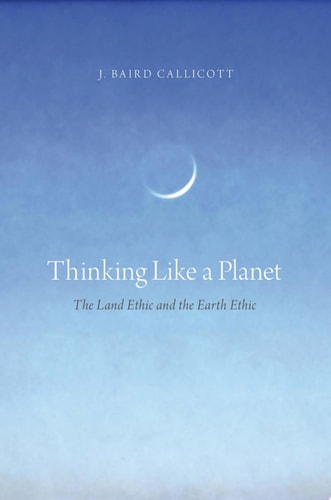
The Land Ethic and the Earth Ethic
0
0
As an Amazon Associate and affiliate partner, Menrva Books earns from qualifying purchases. Learn more
Author Description
Bringing together ecology, evolutionary moral psychology, and environmental ethics, J. Baird Callicott counters the narrative of blame and despair that prevails in contemporary discussions of climate ethics and offers a fresh, more optimistic approach. Whereas other environmental ethicists limit themselves to what Callicott calls Rational Individualism in discussing the problem of climate change only to conclude that, essentially, there is little hope that anything will be done in the face of its "perfect moral storm" (in Stephen Gardiner's words), Callicott refuses to accept this view. Instead, he encourages us to look to the Earth itself, and consider the crisis on grander spatial and temporal scales, as we have failed to in the past. Callicott supports this theory by exploring and enhancing Aldo Leopold's faint sketch of an Earth ethic in "Some Fundamentals of Conservation in the Southwest," a seldom-studied text from the early days of environmental ethics that was written in 1923 but not published until 1979 after the environmental movement gathered strength.
Menrva's Summary
THE THESIS
Can a shift from individualistic moral frameworks to a broader, Earth-centered perspective provide a viable path forward for addressing the climate crisis? J. Baird Callicott, a prominent scholar in environmental philosophy, utilizes his expertise in evolutionary moral psychology and ecological theory to challenge the prevailing narrative of climate despair. He argues that the current reliance on Rational Individualism limits our capacity to act, proposing instead that we adopt a more expansive spatial and temporal view of our relationship with the planet.
THE SCOPE MAP
What You Will Find
- An analysis of Aldo Leopold's 1923 essay, "Some Fundamentals of Conservation in the Southwest."
- A critique of Rational Individualism as a framework for climate ethics.
- Integration of evolutionary moral psychology with contemporary ecological data.
- A theoretical expansion of the Earth ethic to address global climate change.
THE AUTHORITY PERSPECTIVE
Scholars and environmental ethicists recognize this work as a significant contribution to the ongoing discourse regarding the limitations of individual-focused moral philosophy. Readers frequently note the academic density of the prose, which requires a foundational understanding of environmental philosophy to fully grasp the author's arguments.
Page Count:
374
Publication Date:
2014-01-01
Publisher:
Oxford University Press
ISBN-10:
0199324905
ISBN-13:
9780199324903
Philosophy
Ecology
Public Policy
Nature
Climate Change
Community Tags
Similar Books