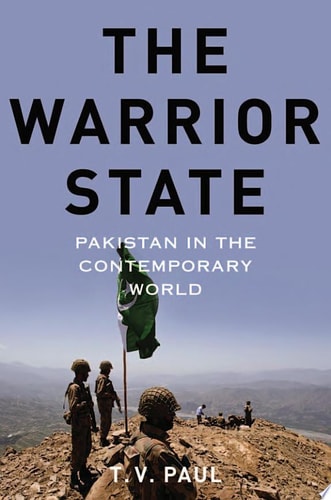
Warrior State: Pakistan in the Contemporary World
0
0
As an Amazon Associate and affiliate partner, Menrva Books earns from qualifying purchases. Learn more
Author Description
Seemingly from its birth, Pakistan has teetered on the brink of becoming a failed state. Today, it ranks 133rd out of 148 countries in global competitiveness. Its economy is as dysfunctional as its political system is corrupt; both rely heavily on international aid for their existence. Taliban forces occupy 30 percent of the country. It possesses over a hundred nuclear weapons that could easily fall into terrorists' hands. Why, in an era when countries across the developing world are experiencing impressive economic growth and building democratic institutions, has Pakistan been such a conspicuous failure? In The Warrior State, noted international relations and South Asia scholar T.V. Paul untangles this fascinating riddle. Paul argues that the geostrategic curse--akin to the resource curse that plagues oil-rich autocracies--is at the root of Pakistan's unique inability to progress. Since its founding in 1947, Pakistan has been at the center of major geopolitical struggles: the US-Soviet rivalry, the conflict with India, and most recently the post 9/11 wars. No matter how ineffective the regime is, massive foreign aid keeps pouring in from major powers and their allies with a stake in the region. The reliability of such aid defuses any pressure on political elites to launch the far-reaching domestic reforms necessary to promote sustained growth, higher standards of living, and more stable democratic institutions. Paul shows that excessive war-making efforts have drained Pakistan's limited economic resources without making the country safer or more stable. Indeed, despite the regime's emphasis on security, the country continues to be beset by widespread violence and terrorism. In an age of transnational terrorism and nuclear proliferation, understanding Pakistan's development, particularly the negative effects of foreign aid and geopolitical centrality, is more important than ever.
Menrva's Summary
THE THESIS
This book investigates why Pakistan has consistently failed to develop stable democratic institutions and economic prosperity despite its significant geopolitical importance. T. V. Paul, a distinguished scholar of international relations and South Asian studies, utilizes a framework centered on the concept of the geostrategic curse. He argues that Pakistan's reliance on foreign aid, driven by its central role in global conflicts since 1947, has insulated its political elites from the necessity of domestic reform and economic modernization.
THE SCOPE MAP
What You Will Find
- Analysis of the geostrategic curse as a parallel to the resource curse in political economy.
- Historical examination of Pakistan's involvement in the US-Soviet rivalry, conflicts with India, and post-9/11 wars.
- Evaluation of how foreign aid dependency undermines domestic political and economic stability.
- Assessment of the relationship between excessive military spending and the persistence of internal terrorism.
THE AUTHORITY PERSPECTIVE
Experts and political analysts recognize this work as a critical contribution to understanding the structural impediments to development in South Asia. Readers frequently note the clarity of the author's argument regarding the negative impacts of external aid on state-building processes.
Page Count:
288
Publication Date:
2013-01-01
Publisher:
Oxford University Press, Incorporated
ISBN-10:
0199322244
ISBN-13:
9780199322244
History
Economics
Pakistan
South Asia
International relations
Community Tags
Similar Books