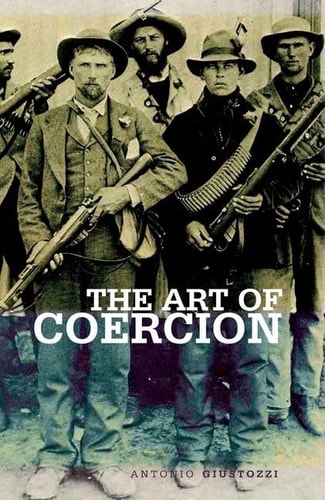
Art of Coercion: The Primitive Accumulation and Management of Coercive Power
0
0
As an Amazon Associate and affiliate partner, Menrva Books earns from qualifying purchases. Learn more
Author Description
In today's dominant discourse of liberal interventionism, the role of coercion and the monopoly of violence have been neglected, argues Antonio Giustozzi, an analyst justly renowned for his research and writing on the Taliban. It is widely assumed that a functional, liberal state can emerge out of a political settlement between warring parties based on political inclusiveness and a social contract, which involves pressuring political actors to reach a deal. But the post-Cold war experience of such deals has been so disappointing that a re-examination of these 'certainties' is warranted. Giustozzi contends that a key source of such flawed analyses is widespread confusion over what state formation and state-building involve. In his view, completely different 'rules of the game' apply to the two. Naked coercion is a key component of state formation, and very few states were formed without recourse to it. In contrast, the history of state consolidation after their initial formation is one of taming violence and creating increasingly sophisticated way of managing it.The Art of Coercion offers a new approach to thinking about the role of security forces, in their broadest sense, in this transition between state formation and state-building. While focussing largely on the nineteenth and twentieth centuries, Giustozzi discusses coercive power throughout history, from the Carolingian empire to the Boer War, from Zapata's Mexico to China's Warring States. He scrutinises the role of armies, guerrilla bands, mercenaries, police forces and intelligence services, analyses why some coups fail and some succeed, and examines the ways in which the monopoly of violence decays.
Menrva's Summary
THE THESIS
This work investigates the fundamental role of coercion and the monopoly of violence in the processes of state formation and state-building. Antonio Giustozzi, a noted expert on conflict and the Taliban, challenges the prevailing liberal interventionist consensus that prioritizes political settlements over the realities of power. By analyzing historical transitions from the formation of states through naked force to their subsequent consolidation via the management of violence, the author provides a framework for understanding why many modern state-building efforts fail to achieve stability.
THE SCOPE MAP
What You Will Find
- Historical analysis of state formation from the Carolingian Empire to the Boer War and revolutionary Mexico.
- Examination of the transition from raw coercive power to institutionalized security management.
- Comparative study of diverse security actors including armies, guerrilla bands, mercenaries, and intelligence services.
- Theoretical exploration of why monopolies of violence decay and the mechanics behind successful or failed coups.
THE AUTHORITY PERSPECTIVE
Experts recognize this text as a critical intervention in political science that forces a re-evaluation of post-Cold War state-building strategies. Readers frequently note the academic density of the prose and the breadth of historical examples used to support the author's arguments.
Page Count:
256
Publication Date:
2011-03-29
Publisher:
Oxford University Press
ISBN-10:
0199327416
ISBN-13:
9780199327416
History
Politics
Sociology
International relations
New Used & Rental Textbooks
Military History
Community Tags
Similar Books