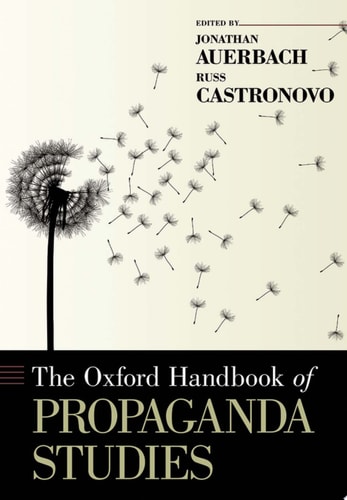
The Oxford Handbook of Propaganda Studies (Oxford Handbooks)
0
0
As an Amazon Associate and affiliate partner, Menrva Books earns from qualifying purchases. Learn more
Author Description
Derived from the word "to propagate," the idea and practice of propaganda concerns nothing less than the ways in which human beings communicate, particularly with respect to the creation and widespread dissemination of attitudes, images, and beliefs. Much larger than its pejorative connotations suggest, propaganda can more neutrally be understood as a central means of organizing and shaping thought and perception, a practice that has been a pervasive feature of the twentieth century and that touches on many fields. It has been seen as both a positive and negative force, although abuses under the Third Reich and during the Cold War have caused the term to stand in, most recently, as a synonym for untruth and brazen manipulation.Propaganda analysis of the 1950s to 1989 too often took the form of empirical studies about the efficacy of specific methods, with larger questions about the purposes and patterns of mass persuasion remaining unanswered. In the present moment where globalization and transnationality are arguably as important as older nation forms, when media enjoy near ubiquity throughout the globe, when various fundamentalisms are ascendant, and when debates rage about neoliberalism, it is urgent that we have an up-to-date resource that considers propaganda as a force of culture writ large.The handbook will include twenty-two essays by leading scholars from a variety of disciplines, divided into three sections. In addition to dealing with the thorny question of definition, the handbook will take up an expansive set of assumptions and a full range of approaches that move propaganda beyond political campaigns and warfare to examine a wide array of cultural contexts and practices.
Menrva's Summary
THE THESIS
This volume investigates the multifaceted nature of propaganda as a fundamental mechanism for organizing and shaping human thought, perception, and cultural belief systems. Editors Jonathan Auerbach and Russ Castronovo curate a collection of essays from leading scholars to move beyond the narrow, pejorative definitions of propaganda associated with twentieth-century warfare. By examining the intersection of globalization, media ubiquity, and neoliberalism, the text provides a comprehensive framework for understanding how mass persuasion functions as a pervasive cultural force in the modern era.
THE SCOPE MAP
What You Will Find
- Twenty-two scholarly essays covering the historical and theoretical evolution of propaganda studies.
- Analysis of propaganda's role in shaping transnational and globalized cultural contexts.
- Methodological approaches that move beyond empirical studies of political efficacy to broader cultural critique.
- Examination of the definition and assumptions surrounding mass persuasion in the context of contemporary media.
THE AUTHORITY PERSPECTIVE
Scholars and students of media studies frequently cite this handbook as a foundational resource for re-evaluating propaganda outside of strictly political or wartime contexts. The text is noted for its academic rigor and its ability to synthesize diverse disciplinary perspectives into a coherent study of mass communication.
Page Count:
482
Publication Date:
2013-01-01
Publisher:
Oxford University Press
ISBN-10:
0199331855
ISBN-13:
9780199331857
History
Communications
English
Communication Studies
English & College Success
Propaganda
Media Studies
Sociology
Introduction to Human Communication
Reference
Community Tags
Similar Books