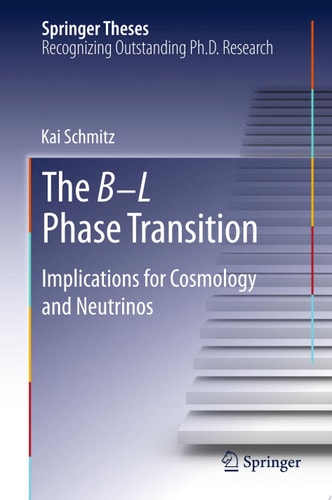
The B-L Phase Transition Implications For Cosmology And Neutrinos
0
0
As an Amazon Associate and affiliate partner, Menrva Books earns from qualifying purchases. Learn more
Author Description
Several of the very foundations of the cosmological standard model — the baryon asymmetry of the universe, dark matter, and the origin of the hot big bang itself — still call for an explanation from the perspective of fundamental physics. This work advocates one intriguing possibility for a consistent cosmology that fills in the theoretical gaps while being fully in accordance with the observational data. At very high energies, the universe might have been in a false vacuum state that preserved B-L, the difference between the baryon number B and the lepton number L as a local symmetry. In this state, the universe experienced a stage of hybrid inflation that only ended when the false vacuum became unstable and decayed, in the course of a waterfall transition, into a phase with spontaneously broken B-L symmetry. This B-L Phase Transition was accompanied by tachyonic preheating that transferred almost the entire energy of the false vacuum into a gas of B-L Higgs bosons, which in turn decayed into heavy Majorana neutrinos. Eventually, these neutrinos decayed into massless radiation, thereby producing the entropy of the hot big bang, generating the baryon asymmetry of the universe via the leptogenesis mechanism and setting the stage for the production of dark matter. Next to a variety of conceptual novelties and phenomenological predictions, the main achievement of the thesis is hence the fascinating notion that the leading role in the first act of our universe might have actually been played by neutrinos.
Menrva's Summary
THE THESIS
This work proposes a unified theoretical framework for several fundamental cosmological puzzles, including the baryon asymmetry, dark matter, and the origin of the Big Bang. The author, Kai Schmitz, advocates for a model where the early universe existed in a false vacuum state preserving B-L symmetry, which then underwent a hybrid inflation and decay into a phase with spontaneously broken B-L symmetry. This transition, driven by tachyonic preheating, converted vacuum energy into B-L Higgs bosons, which subsequently decayed into heavy Majorana neutrinos. These neutrinos, in turn, decayed to produce the entropy of the hot Big Bang, generate baryon asymmetry via leptogenesis, and set the stage for dark matter production.
THE SCOPE MAP
- Explores the baryon asymmetry of the universe as a consequence of fundamental physics.
- Investigates dark matter within a unified cosmological model.
- Proposes a novel explanation for the origin of the hot Big Bang.
- Details a hybrid inflation model in a false vacuum state preserving B-L symmetry.
- Describes the decay of the false vacuum via a waterfall transition into a spontaneously broken B-L symmetry phase.
- Explains the role of tachyonic preheating in transferring vacuum energy to B-L Higgs bosons.
- Connects the decay of heavy Majorana neutrinos to entropy production and baryon asymmetry (leptogenesis).
- Posits neutrinos as playing a leading role in the early universe's evolution.
THE AUTHORITY PERSPECTIVE
This work presents a detailed theoretical exploration of early universe cosmology, focusing on particle physics mechanisms to explain key cosmological observations. It delves into complex concepts such as B-L symmetry, hybrid inflation, and leptogenesis, suggesting a significant role for neutrinos in the universe's genesis. The thesis offers novel predictions and conceptual advancements within the field of theoretical cosmology.
Page Count:
221
Publication Date:
2013-01-01
ISBN-10:
3319009621
ISBN-13:
9783319009629
Art
Science
Non-Fiction
Particle Physics
Cosmology
Neutrinos
Theoretical Physics
Community Tags
Similar Books