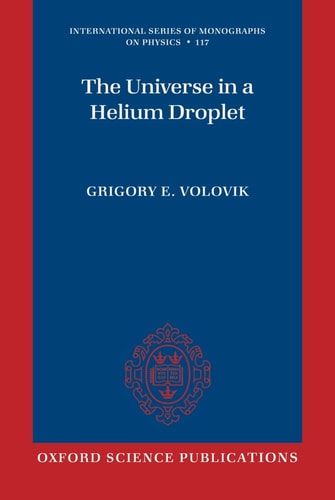
The Universe in a Helium Droplet
0
0
As an Amazon Associate and affiliate partner, Menrva Books earns from qualifying purchases. Learn more
Author Description
There are fundamental relations between three vast areas of physics: particle physics, cosmology and condensed matter physics. The fundamental links between the first two areas, in other words, between micro- and macro- worlds, have been well established. There is a unified system of laws governing the scales from subatomic particles to the Cosmos and this principle is widely exploited in the description of the physics of the early Universe. The main goal of this book is to establish and define the connection of these two fields with condensed matter physics. According to the modern view, elementary particles (electrons, neutrinos, quarks, etc.) are excitations of a more fundamental medium called the quantum vacuum. This is the new 'aether' of the 21st Century. Electromagnetism, gravity, and the fields transferring weak and strong interactions all represent different types of the collective motion of the quantum vacuum. Among the existing condensed matter systems, a quantum liquid called superfluid 3He-A most closely represents the quantum vacuum. Its quasiparticles are very similar to the elementary particles, while the collective modes of the liquid are very similar to electromagnetic and gravitational fields, and the quanta of these collective modes are analogues of photons and gravitons. The fundamental laws of physics, such as the laws of relativity (Lorentz invariance) and gauge invariance, arise when the temperature of the quantum liquid decreases. This book is written for graduate students and researchers in all areas of physics.
Menrva's Summary
THE THESIS
This book investigates the fundamental physical analogies between the quantum vacuum and condensed matter systems, specifically superfluid 3He-A. Grigory E. Volovik, a prominent researcher in condensed matter physics, utilizes the framework of quantum liquid dynamics to argue that elementary particles and fundamental forces can be understood as collective excitations of a vacuum medium. By drawing parallels between the early Universe and superfluid behavior, the author provides a theoretical bridge between micro-scale particle physics and macro-scale cosmology.
THE SCOPE MAP
What You Will Find
- Theoretical analysis of superfluid 3He-A as an analogue for the quantum vacuum
- Mathematical derivations linking quasiparticles to elementary particles
- Exploration of emergent phenomena such as Lorentz invariance and gauge invariance
- Comparative study of collective modes in liquids versus electromagnetic and gravitational fields
Scope Limits
- The text assumes a high level of prior knowledge in quantum field theory and statistical mechanics
- It does not provide an introductory overview of standard model physics for lay readers
THE AUTHORITY PERSPECTIVE
Experts and researchers in theoretical physics recognize this work as a significant contribution to the study of emergent phenomena in quantum systems. Readers frequently note the high level of mathematical and conceptual density, identifying it as a specialized text intended for graduate-level study and professional research.
Page Count:
536
Publication Date:
2003-01-01
Publisher:
OUP Oxford
ISBN-10:
0191574090
ISBN-13:
9780191574092
Theoretical Physics
Condensed Matter Physics
Cosmology
Physics
Earth Sciences
Particle Physics