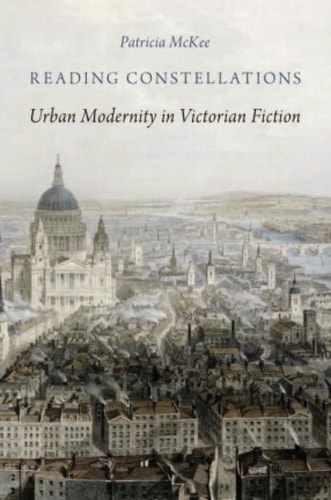
Reading Constellations: Urban Modernity in Victorian Fiction
0
0
As an Amazon Associate and affiliate partner, Menrva Books earns from qualifying purchases. Learn more
Author Description
The changes wrought by industrialization in the nineteenth century were heralded by many as the inevitable march of progress. Yet a fair share of critics opposed the encroachment of modernity into everyday life. Wedding Walter Benjamin's critique of urban modernity with several canonical works of fiction, Patricia McKee's study challenges the traditional ways we look at Victorian literature and culture. In Great Expectations, Our Mutual Friend, Jude the Obscure, and "In the Cage," characters struggle to find a place for the parts of the self that do not fit the conventional image of middle-class Victorian success in the rapidly expanding world of metropolitan London. Reading Constellations focuses on this tension, exploring how characters attempt to fit in or adapt to urban society. Throughout, Patricia McKee draws on Walter Benjamin's philosophy of history to examine the aforementioned works of fiction by Dickens, Hardy, and James. The dialectical notion of the "constellation" is deployed in each chapter to read moments in which past and present collide and the ways these writers "open out" the representation of the city to new modes of articulation and-through narrative perception-the reader's perception of the phenomena of the city, its place as the exemplar of modernity, and the ways in which it determines subjectivity. Benjamin's concept of "colportage" is also used as a tool to demonstrate how Victorian fiction distributes and alters various possibilities in time and space. Ultimately, Reading Constellations demonstrates how Victorian fiction imagines a version of urban modernity that compensates for capitalist development, reassembling parts of experience that capitalism typically disintegrates.
Menrva's Summary
THE THESIS
This book investigates how Victorian fiction constructs a version of urban modernity that attempts to reconcile the fragmented human experience caused by rapid capitalist development. Patricia McKee, a scholar of nineteenth-century literature, utilizes the philosophical framework of Walter Benjamin to analyze canonical texts by Charles Dickens, Thomas Hardy, and Henry James. By applying concepts such as the 'constellation' and 'colportage,' the study argues that these authors utilized narrative techniques to articulate the collision of past and present within the expanding metropolitan environment of London.
THE SCOPE MAP
What You Will Find
- Analysis of canonical Victorian texts including Great Expectations, Our Mutual Friend, Jude the Obscure, and In the Cage.
- Application of Walter Benjamin's dialectical philosophy to literary narrative structures.
- Examination of the relationship between urban industrialization and the formation of individual subjectivity.
- Theoretical exploration of how narrative perception alters the reader's understanding of city phenomena.
THE AUTHORITY PERSPECTIVE
Scholars in the field of Victorian studies frequently cite this work for its sophisticated integration of continental philosophy with nineteenth-century narrative analysis. Experts note that the text provides a dense, rigorous methodology for understanding how literature functions as a response to the pressures of urban modernity.
Page Count:
208
Publication Date:
2014-01-01
Publisher:
Oxford University Press
ISBN-10:
0199333912
ISBN-13:
9780199333912
Philosophy
Urban Studies
Literary Criticism
English
In literature
English & College Success
Cultural History
Victorian
Community Tags
Similar Books