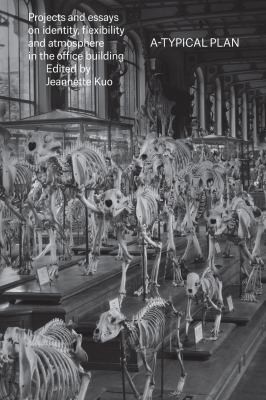
A-Typical Plan
0
0
As an Amazon Associate and affiliate partner, Menrva Books earns from qualifying purchases. Learn more
Author Description
As a typology conceived in the twentieth century, the office building is often the architectural manifestation - not only of global capital, but also of technological might and mass production. But when we think of these buildings, we often think more of objects than of space; more of appearance than of atmosphere. In A-Typical Plan, Jeannette Kuo offers a reversal of the experience, starting from the inside out, and prioritizing space over symbol. In particular, the book reconsiders the deep plan within the European context for a discussion on density, economy and, not least, sustainability. Featuring buildings by architects such as Frank Lloyd Wright, Kenzo Tange, Giuseppe Terragni, Le Corbusier, SANAA, Herzog & de Meuron, Toyo Ito, Christian Kerez, and many others, A-Typical Plan presents a collection of projects through history that have attempted to bring character to the deep plan as a spatial experience for the workspace. The work features essays by renowned authors, including Iñaki Ábalos, Pier Vittorio Aureli, Andrea Bassi, Florian Idenburg, Jeannette Kuo, Freek Persyn, and Antoine Picon. A conversation with Inès Lamunière and a graphic essay by Jimenez Lai round out the diverse perspectives. A final chapter presents the work of students at the EPFL, with whom this research began. Succinct and beautifully illustrated, A-Typical Plan is a reminder that even buildings created for quotidian uses can be spatially and experientially rich.
Menrva's Summary
THE THESIS
The book investigates the architectural typology of the deep plan office building, challenging its common perception as a mere symbol of capital and technology. Jeannette Kuo reorients the understanding of these structures by prioritizing spatial experience over symbolic representation, examining the deep plan within a European context. The analysis focuses on density, economy, and sustainability, presenting a collection of historical and contemporary projects that imbue the workspace with character. The work is enriched by essays from notable authors, a conversation, a graphic essay, and student research, ultimately demonstrating the spatial and experiential richness achievable even in quotidian building types.
THE SCOPE MAP
- Analysis of the deep plan office building typology, moving beyond its symbolic associations.
- Exploration of density, economy, and sustainability within the European architectural context.
- Case studies featuring architects such as Frank Lloyd Wright, Kenzo Tange, Le Corbusier, SANAA, and Herzog & de Meuron.
- Essays by Iñaki Ábalos, Pier Vittorio Aureli, Florian Idenburg, and others.
- A conversation with Inès Lamunière and a graphic essay by Jimenez Lai.
- A final chapter showcasing student research from EPFL.
- Focus on bringing character and spatial richness to the workspace.
THE AUTHORITY PERSPECTIVE
This book is positioned as a scholarly examination of architectural typology, specifically focusing on the deep plan office building. Its approach, starting from the inside out and prioritizing space over symbol, suggests a critical re-evaluation of a common building form. The inclusion of essays by renowned authors and a diverse range of architectural examples indicates a comprehensive and multi-faceted study intended for architects, urban planners, and students of architecture.
Page Count:
202
Publication Date:
2013-01-01
ISBN-10:
3906027090
ISBN-13:
9783906027098
Non-Fiction
Architecture
Sustainability
Design
urban planning
Community Tags
Similar Books