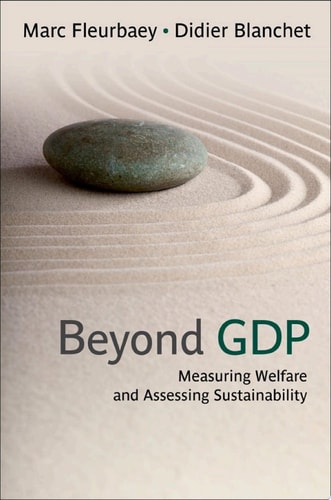
Beyond GDP: Measuring Welfare and Assessing Sustainability
0
0
As an Amazon Associate and affiliate partner, Menrva Books earns from qualifying purchases. Learn more
Author Description
In spite of recurrent criticism and an impressive production of alternative indicators by scholars and NGOs, GDP remains the central indicator of countries' success. This book revisits the foundations of indicators of social welfare, and critically examines the four main alternatives to GDP that have been proposed: composite indicators, subjective well-being indexes, capabilities (the underlying philosophy of the Human Development Index), and equivalent incomes. Its provocative thesis is that the problem with GDP is not that it uses a monetary metric but that it focuses on a narrow set of aspects of individual lives. It is actually possible to build an alternative, more comprehensive, monetary indicator that takes income as its first benchmark and adds or subtracts corrections that represent the benefit or cost of non-market aspects of individual lives. Such a measure can respect the values and preferences of the people and give as much weight as they do to the non-market dimensions. A further provocative idea is that, in contrast, most of the currently available alternative indicators, including subjective well-being indexes, are not as respectful of people's values because, like GDP, they are too narrow and give specific weights to the various dimensions of life in a more uniform way, without taking account of the diversity of views on life in the population. The popular attraction that such alternative indicators derive from being non-monetary is therefore based on equivocation. Moreover, it is argued in this book that "greening" GDP and relative indicators is not the proper way to incorporate sustainability concerns. Sustainability involves predicting possible future paths, therefore different indicators than those assessing the current situation. While various indicators have been popular (adjusted net savings, ecological footprint), none of them involves the necessary forecasting effort that a proper evaluation of possible futures requires.
Menrva's Summary
THE THESIS
This book investigates why GDP remains the dominant metric for national success and proposes a more comprehensive monetary indicator that better reflects individual welfare and sustainability. The authors, Didier Blanchet and Marc Fleurbaey, utilize their expertise in economic theory and social indicators to challenge the current reliance on narrow metrics. They argue that the primary issue with GDP is its limited scope rather than its monetary nature, suggesting that a refined monetary measure can better incorporate non-market aspects of life while respecting diverse individual preferences.
THE SCOPE MAP
What You Will Find
- A critical examination of four primary alternatives to GDP: composite indicators, subjective well-being indexes, capabilities, and equivalent incomes.
- A theoretical framework for constructing a comprehensive monetary indicator that accounts for non-market benefits and costs.
- An analysis of the limitations of current sustainability indicators like adjusted net savings and the ecological footprint.
- A methodological argument for integrating forecasting efforts into the evaluation of future sustainability paths.
THE AUTHORITY PERSPECTIVE
Experts in the field of welfare economics recognize this work as a rigorous challenge to conventional indicator development. Readers frequently note the academic density of the prose, which serves as a foundational text for those interested in the intersection of economic measurement and social policy.
Page Count:
336
Publication Date:
2013-01-01
Publisher:
Oxford University Press
ISBN-10:
0199346917
ISBN-13:
9780199346912
Economics
Social Science
Statistics
Sustainability
Principles of Macroeconomics
Public Policy
Community Tags
Similar Books