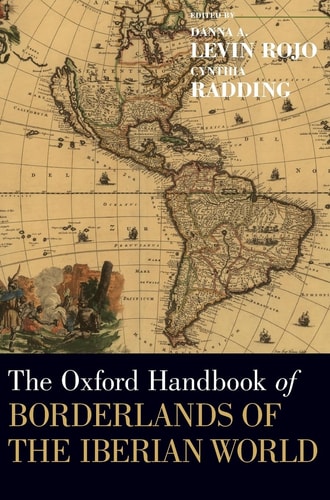
The Oxford Handbook of Borderlands of the Iberian World
0
0
As an Amazon Associate and affiliate partner, Menrva Books earns from qualifying purchases. Learn more
Author Description
This collaborative multi-authored volume integrates interdisciplinary approaches to ethnic, imperial, and national borderlands in the Iberian World (16th to early 19th centuries). It illustrates the historical processes that produced borderlands in the Americas and connected them to global circuits of exchange and migration in the early modern world. The book offers a balanced state-of-the-art educational tool representing innovative research for teaching and scholarship. Its geographical scope encompasses imperial borderlands in what today is northern Mexico and southern United States; the greater Caribbean basin, including cross-imperial borderlands among the island archipelagos and Central America; the greater Paraguayan river basin, including the Gran Chaco, lowland Brazil, Paraguay, and Bolivia; the Amazonian borderlands; the grasslands and steppes of southern Argentina and Chile; and Iberian trade and religious networks connecting the Americas to Africa and Asia. The volume is structured around the following broad themes: environmental change and humanly crafted landscapes; the role of indigenous allies in the Spanish and Portuguese military expeditions; negotiations of power across imperial lines and indigenous chiefdoms; the parallel development of subsistence and commercial economies across terrestrial and maritime trade routes; labor and the corridors of forced and free migration that led to changing social and ethnic identities; histories of science and cartography; Christian missions, music, and visual arts; gender and sexuality, emphasizing distinct roles and experiences documented for men and women in the borderlands. While centered in the colonial era, it is framed by pre-contact Mesoamerican borderlands and nineteenth-century national developments for those regions where the continuity of inter-ethnic relations and economic networks between the colonial and national periods is particularly salient, like the central Andes, lowland Bolivia, central Bra
Menrva's Summary
THE THESIS
This volume investigates the complex historical processes that defined ethnic, imperial, and national borderlands within the Iberian World from the 16th to the early 19th centuries. Editors Cynthia Radding and Danna A. Levin Rojo assemble a multi-disciplinary team of scholars to analyze how these regions functioned as critical nodes in global circuits of exchange. By integrating environmental, social, and political data, the authors argue that borderlands were not merely peripheral zones but central drivers of colonial development and identity formation.
THE SCOPE MAP
What You Will Find
- Comprehensive coverage of geographical regions including northern Mexico, the Caribbean basin, the Amazon, and the Gran Chaco.
- Analysis of cross-imperial trade networks connecting the Americas to Africa and Asia.
- Examination of indigenous agency in military, economic, and religious negotiations.
- Methodological frameworks for studying cartography, environmental change, and gender roles in colonial contexts.
THE AUTHORITY PERSPECTIVE
Experts recognize this handbook as a foundational reference for scholars and students of colonial history and borderlands studies. Readers frequently note the academic density of the prose and the breadth of the interdisciplinary research presented throughout the volume.
Page Count:
928
Publication Date:
2019-12-04
Publisher:
Oxford University Press
ISBN-10:
019934177X
ISBN-13:
9780199341771
History
America history
Academic
Iberian History
Colonial History
Community Tags
Other Editions(2)
Similar Books



Reader Comments
Share Your Thoughts
No comments yet. Be the first to share your thoughts!