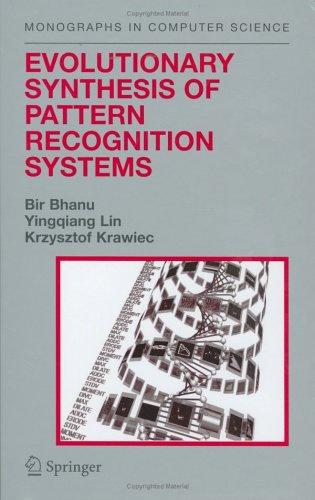
Evolutionary Synthesis of Pattern Recognition Systems
0
0
As an Amazon Associate and affiliate partner, Menrva Books earns from qualifying purchases. Learn more
Author Description
Designing object detection and recognition systems that work in the real world is a challenging task due to various factors including the high complexity of the systems, the dynamically changing environment of the real world and factors such as occlusion, clutter, articulation, and various noise contributions that make the extraction of reliable features quite difficult. Evolutionary Synthesis of Pattern Recognition Systems presents novel effective approaches based on evolutionary computational techniques, such as genetic programming (GP), linear genetic programming (LGP), coevolutionary genetic programming (CGP) and genetic algorithms (GA) to automate the synthesis and analysis of object detection and recognition systems. The book’s concepts, principles, and methodologies will enable readers to automatically build robust and flexible systems—in a systematic manner—that can provide human-competitive performance and reduce the cost of designing and maintaining these systems. Its content covers all key aspects of object recognition: object detection, feature selection, feature discovery, object recognition, domain knowledge. Basic knowledge of programming and data structures, and some calculus, is presupposed. Topics and Features: *Presents integrated coverage of object detection/recognition systems *Describes how new system features can be generated "on the fly," and how systems can be made flexible and applied to a variety of objects and images *Demonstrates how object detection and recognition systems can be automatically designed and maintained in a relatively inexpensive way *Explains automatic synthesis and creation of programs (which saves valuable human and economic resources) *Focuses on results using real-world imagery, thereby concretizing the book’s novel ideas This accessible monograph provides the computational foundation for evolutionary synthesis involving pattern recognition and is an ideal overview of the latest concepts and technologies. Computer
Menrva's Summary
THE THESIS
This book investigates how evolutionary computational techniques can automate the design and analysis of object detection and recognition systems. The author, Bir Bhanu, addresses the inherent challenges in creating real-world pattern recognition systems, such as environmental dynamism, occlusion, clutter, and noise, which complicate reliable feature extraction. The book proposes novel approaches using genetic programming (GP), linear genetic programming (LGP), coevolutionary genetic programming (CGP), and genetic algorithms (GA) to build robust, flexible, and cost-effective systems. These methodologies aim to enable readers to automatically construct systems that achieve human-competitive performance.
THE SCOPE MAP
- Presents integrated coverage of object detection and recognition systems.
- Describes how new system features can be generated dynamically.
- Explains how systems can be made flexible and applied to a variety of objects and images.
- Demonstrates automatic design and maintenance of object detection and recognition systems in a cost-effective manner.
- Explains automatic synthesis and creation of programs to save human and economic resources.
- Focuses on results using real-world imagery to illustrate novel ideas.
- Covers key aspects of object recognition: object detection, feature selection, feature discovery, object recognition, and domain knowledge.
THE AUTHORITY PERSPECTIVE
The book presents novel approaches to automating the synthesis and analysis of object detection and recognition systems using evolutionary computational techniques. It aims to provide readers with the knowledge to build robust and flexible systems efficiently. The content covers essential aspects of object recognition, including feature selection and discovery, and is supported by real-world imagery. The subject matter points to a dense, specialist text suitable for researchers and practitioners in computer vision and artificial intelligence.
Page Count:
296
Publication Date:
2005-01-01
ISBN-10:
0387212957
ISBN-13:
9780387212951
Science
Action
Art
Non-Fiction
Computer Science
Machine Learning
Community Tags
Similar Books