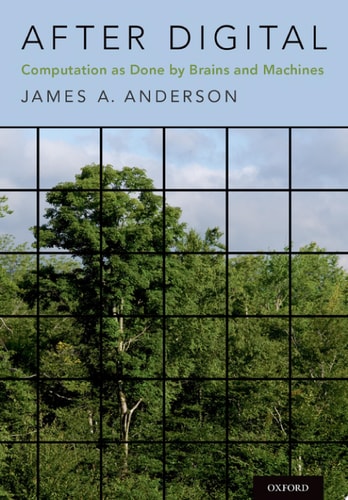
After Digital: Computation as Done by Brains and Machines
0
0
As an Amazon Associate and affiliate partner, Menrva Books earns from qualifying purchases. Learn more
Author Description
Current computer technology doubles in in power roughly every two years, an increase called "Moore's Law." This constant increase is predicted to come to an end soon. Digital technology will change. Although digital computers dominate today's world, there are alternative ways to "compute" which might be better and more efficient than digital computation. After Digital looks at where the field of computation began and where it might be headed, and offers predictions about a collaborative future relationship between human cognition and mechanical computation.James A. Anderson, a pioneer of biologically inspired neural nets, presents two different kinds of computation-digital and analog--and gives examples of their history, function, and limitations. A third, the brain, falls somewhere in between these two forms, and is suggested as a computer architecture that is more capable of performing some specific important cognitive tasks-perception, reasoning, and intuition, for example- than a digital computer, even though the digital computer is constructed from far faster and more reliable basic elements. Anderson discusses the essentials of brain hardware, in particular, the cerebral cortex, and how cortical structure can influence the form taken by the computational operations underlying cognition. Topics include association, understanding complex systems through analogy, formation of abstractions, the biology of number and its use in arithmetic and mathematics, and computing across scales of organization. These applications, of great human interest, also form the goals of genuine artificial intelligence. After Digital will appeal to a broad cognitive science community, including computer scientists, philosophers, psychologists, and neuroscientists, as well as the curious science layreader, and will help to understand and shape future developments in computation.
Menrva's Summary
THE THESIS
This book investigates the limitations of current digital computing paradigms and proposes that future advancements in artificial intelligence will require a synthesis of digital logic with the analog, biologically inspired architectures found in the human brain. James A. Anderson, a foundational figure in neural network research, leverages his extensive background in cognitive science and biology to contrast the rigid precision of digital machines with the flexible, associative nature of cortical processing. He argues that while digital computers excel at speed and reliability, they lack the inherent capacity for perception, intuition, and complex abstraction that characterizes human cognition. By examining the intersection of these two computational domains, the author provides a framework for understanding how future systems might emulate the brain's unique ability to handle high-level cognitive tasks.
THE SCOPE MAP
What You Will Find
- Comparative analysis of digital, analog, and biological computational architectures.
- Examination of the cerebral cortex as a model for advanced cognitive processing.
- Discussion on the evolution of artificial intelligence and the biology of mathematical reasoning.
- Exploration of association, abstraction, and multi-scale organization in complex systems.
THE AUTHORITY PERSPECTIVE
Experts recognize this work as a significant contribution to the discourse on the future of computing, particularly for its bridge between neurobiology and machine learning. Readers frequently note that while the text covers complex technical ground, it remains accessible to a broad audience of scientists and informed laypeople interested in the evolution of artificial intelligence.
Page Count:
400
Publication Date:
2017-04-03
Publisher:
Oxford University Press
ISBN-10:
0199357781
ISBN-13:
9780199357789
Science
Technology
Neuroscience
Computer Science
Psychological aspects
Community Tags
Similar Books