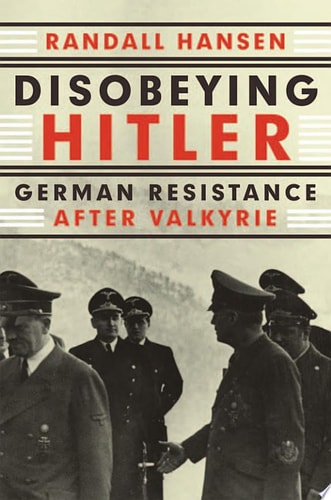
Disobeying Hitler: German Resistance After Valkyrie
0
0
As an Amazon Associate and affiliate partner, Menrva Books earns from qualifying purchases. Learn more
Author Description
On July 20, 1944, Colonel Claus Schenk Graf von Stauffenberg was executed in the courtyard of the Third Reich's military headquarters in Berlin for attempting to assassinate Adolf Hitler. A member of the unsuccessful plot to overthrow the Nazi government -- codenamed Operation Valkyrie -- Stauffenberg was shot by a firing squad along with his co-conspirators, and their bodies were dumped in a shallow grave.Most discussions of German resistance during World War II end here, with the failed July 20 plot and the subsequent execution of its leaders. And yet this was far from the last act of disobedience carried out against the Nazi regime, as Randall Hansen reveals in his fascinating new book. Although "resistance" as a commitment to regime change all but ended with Stauffenberg, Hansen shows that if we consider resistance as disobedience -- of orders to detonate a bridge, to wreck a factory, to destroy a harbor or to defend a city to the last man -- then a very different picture emerges. Resistance-as-disobedience continued, and indeed increased, throughout late 1944 and early 1945. And it had a more profound and lasting material effect on the war and its aftermath than did the military resistance culminating in Stauffenberg's attempt on Hitler's life. From the refusal to destroy Paris and key locations in southern France to the unwillingness to implement a scorched earth policy on German soil, disobedience in the Third Reich manifested in numerous ways after 1944, and ultimately impacted the course of the war by saving thousands of Allied and German lives, keeping supply lines open, and preserving cities and infrastructure. In a period of thorough and at times fanatical obedience, the few instances of disobedience against the Nazi regime become all the more striking. Considering various forms of oppostion across the Western Front, Disobeying Hitler is a significant contribution to the literature on German resistance.
Menrva's Summary
THE THESIS
This book investigates the nature and impact of German resistance to the Nazi regime following the failed July 20, 1944, assassination attempt on Adolf Hitler. Randall Hansen, a scholar of history and political science, challenges the conventional narrative that German resistance effectively ceased after the execution of the Operation Valkyrie conspirators. By redefining resistance as active disobedience to military and scorched-earth orders, Hansen argues that these localized acts of defiance had a more significant material impact on the war's conclusion and the preservation of infrastructure than the high-level military plots.
THE SCOPE MAP
What You Will Find
- Analysis of late-war German military disobedience from late 1944 through 1945.
- Examination of the refusal to execute scorched-earth policies in France and Germany.
- Evidence drawn from military records, command logs, and post-war accounts of German officers.
- Assessment of the strategic impact of disobedience on Allied supply lines and civilian survival.
THE AUTHORITY PERSPECTIVE
Historians and military scholars recognize this work as a necessary expansion of the study of the Third Reich, shifting focus from failed coups to the practical realities of command-level defiance. Readers frequently note the clarity of the author's argument and the effectiveness of his redefinition of resistance in the context of a collapsing regime.
Page Count:
636
Publication Date:
2014-01-01
Publisher:
Oxford University Press
ISBN-10:
0199357994
ISBN-13:
9780199357994
History
Modern History
European History
German history
Political History
Dissenters
Government Resistance To
Military History
Community Tags
Similar Books