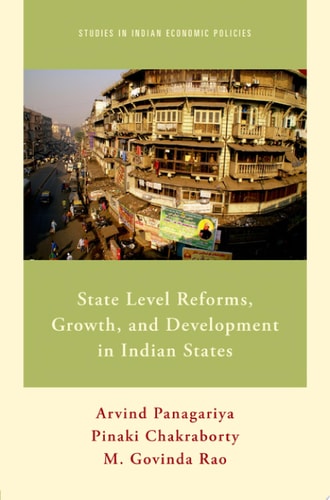
State Level Reforms, Growth, and Development in Indian States
0
0
As an Amazon Associate and affiliate partner, Menrva Books earns from qualifying purchases. Learn more
Author Description
Most discussions of India's recent economic growth focus on progress and policies at the national level. But with a population of 1.2 billion, several of the states in India are larger than many of the countries in the world. Therefore, a more complete understanding of India's ongoing experiment in economic reforms requires a study at the state level.State Level Reforms, Growth, and Development in Indian States provides the first-ever comprehensive analysis of growth and reforms in the highly diverse states of the country. The authors argue that when the national government loosened its controls on industry and services, state governments began shaping the fortunes of their citizens through state-level policy reforms, resulting in faster growth in every state over the last decade than any other decade in the post-independence era. In fact, some of the poorest states, notably Bihar and Odisha, have been growing the fastest.Professors Panagariya and Chakraborty and Dr. Rao refute the common assumptions that growth has not occurred or that poverty has not been reduced in all Indian states. The recent reforms have also led to improved access in every state to basic amenities such as permanent houses, electricity, water, and sanitation. These accomplishments notwithstanding, regional inequality on a per capita basis has grown as well. The authors analyze the economic transformation that has taken place in the largest eighteen states of India and suggest reforms in areas of agriculture, industry, services and urbanization that can further accelerate this transformation. They also provide a comprehensive analysis of education and health in the states.
Menrva's Summary
THE THESIS
This book investigates how state-level policy reforms have driven economic growth and development across India, challenging the national-centric view of the country's economic progress. The authors, Arvind Panagariya, M. Govinda Rao, and Pinaki Chakraborty, utilize extensive economic data from India's eighteen largest states to argue that decentralization has allowed regional governments to significantly influence citizen welfare. By examining shifts in industry, services, and infrastructure, the text provides a framework for understanding how localized policy changes have contributed to poverty reduction and improved access to basic amenities since the post-independence era.
THE SCOPE MAP
What You Will Find
- Comparative analysis of economic growth and reform trajectories across India's eighteen largest states.
- Evaluation of social indicators including education, health, and access to basic amenities like electricity and sanitation.
- Empirical assessment of regional inequality and per capita income disparities.
- Policy recommendations for future development in agriculture, urbanization, and industrial sectors.
THE AUTHORITY PERSPECTIVE
Experts recognize this work as a foundational text for understanding the nuances of India's federal economic structure. Readers frequently note the academic density of the prose and the rigorous use of state-level data to support the authors' arguments.
Page Count:
320
Publication Date:
2014-05-01
Publisher:
Oxford University Press
ISBN-10:
0199367868
ISBN-13:
9780199367863
Economics
Economic systems
Public Policy
India
Community Tags
Similar Books