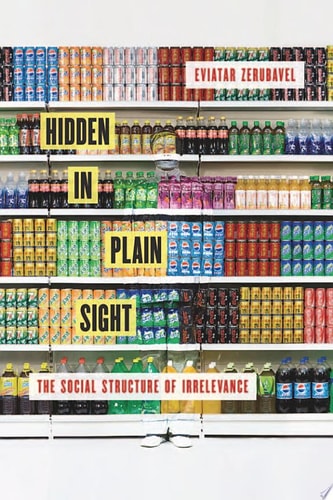
Hidden in Plain Sight: The Social Structure of Irrelevance
0
0
As an Amazon Associate and affiliate partner, Menrva Books earns from qualifying purchases. Learn more
Author Description
Many Of Us Take For Granted That What We Perceive Is A Completely Accurate Representation Of The World Around Us. Yet We Have All Had The Experience Of Suddenly Realizing That The Keys Or Glasses That We Had Been Looking For In Vain Were Right In Front Of Us The Whole Time. The Capacity Of Our Sense Organs Far Exceeds Our Mental Capabilities, And As Such, Looking At Something Does Not Guarantee That We Will Notice It. Our Minds Constantly Prioritize And Organize The Information We Take In, Bringing Certain Things To The Foreground, While Letting Others - That Which We Deem Irrelevant - Recede Into The Background. What Ultimately Determines What We Perceive, And What We Do Not? In This Fascinating Book, Noted Sociologist Eviatar Zerubavel Argues That We Perceive Things Not Just As Human Beings But As Social Beings. Drawing On Fascinating Examples From Science, The Art World, Optical Illusions, And All Walks Of Life, He Shows That What We Notice Or Ignore Varies Across Cultures And Throughout History, And Illustrates How Our Environment And Our Social Lives - Everything From Our Lifestyles To Our Professions To Our Nationalities - Play A Role In Determining How We Actually Use Our Senses To Access The World. A Subtle Yet Powerful Examination Of One Of The Central Features Of Our Conscious Life, This Book Offers A Way To Think About All That Might Otherwise Remain Hidden In Plain Sight.
Menrva's Summary
THE THESIS
This book investigates the social mechanisms that determine why humans perceive certain stimuli while rendering other information irrelevant. Eviatar Zerubavel, a distinguished sociologist, utilizes a framework of cognitive sociology to argue that perception is not merely a biological function but a socially constructed process. By examining how cultural, professional, and historical contexts shape our attention, he demonstrates that our environment dictates the boundaries of our conscious awareness.
THE SCOPE MAP
What You Will Find
- Analysis of cognitive filtering and the social construction of reality
- Cross-disciplinary examples from science, art history, and optical illusions
- Examination of how professional and national identities influence sensory focus
- Theoretical framework for understanding the distinction between the foreground and background of human experience
THE AUTHORITY PERSPECTIVE
Experts in sociology and cognitive studies frequently cite this work as a foundational text for understanding the social dimensions of perception. Readers often note the accessibility of the prose despite the academic depth of the subject matter.
Page Count:
208
Publication Date:
2015-01-01
Publisher:
Oxford University Press, Incorporated
ISBN-10:
0199366624
ISBN-13:
9780199366620
Psychology
Non-Fiction
Attention
Sociology
Social Science
Community Tags
Similar Books