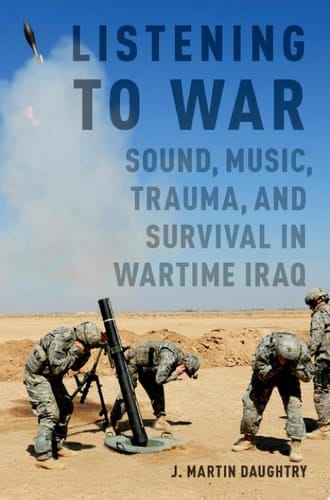
Author Description
To witness war is, in large part, to hear it. And to survive it is, among other things, to have listened to it--and to have listened through it.Listening to War: Sound, Music, Trauma, and Survival in Wartime Iraq is a groundbreaking study of the centrality of listening to the experience of modern warfare. Based on years of ethnographic interviews with U.S. military service members and Iraqi civilians, as well as on direct observations of wartime Iraq, author J. Martin Daughtry reveals how these populations learned to extract valuable information from the ambient soundscape while struggling with the deleterious effects that it produced in their ears, throughout their bodies, and in their psyches. Daughtry examines the dual-edged nature of sound--its potency as a source of information and a source of trauma--within a sophisticated conceptual frame that highlights the affective power of sound and the vulnerability and agency of individual auditors. By theorizing violence through the prism of sound and sound through the prism of violence, Daughtry provides a productive new vantage point for examining these strangely conjoined phenomena. Two chapters dedicated to wartime music in Iraqi and U.S. military contexts show how music was both an important instrument of the military campaign and the victim of a multitude of violent acts throughout the war. A landmark work within the study of conflict, sound studies, and ethnomusicology, Listening to War will expand your understanding of the experience of armed violence, and the experience of sound more generally. At the same time, it provides a discrete window into the lives of individual Iraqis and Americans struggling to orient themselves within the fog of war.
Menrva's Summary
THE THESIS
This book investigates how the auditory experience of modern warfare shapes the survival strategies, psychological health, and cultural expressions of those living through conflict. J. Martin Daughtry, an ethnomusicologist, utilizes years of ethnographic interviews with Iraqi civilians and U.S. military personnel to construct a framework for understanding the duality of sound in war. He argues that sound serves simultaneously as a critical source of tactical information and a primary vector for trauma, requiring individuals to navigate a constant state of hyper-vigilance. By analyzing the intersection of violence and acoustics, the author provides a new methodology for interpreting the sensory reality of armed conflict.
THE SCOPE MAP
What You Will Find
- Ethnographic interviews with Iraqi civilians and U.S. military service members.
- Analysis of the dual role of sound as both a survival tool and a source of psychological trauma.
- Examination of the function of music within both Iraqi cultural contexts and U.S. military operations.
- A conceptual framework for theorizing violence through the prism of sound studies.
THE AUTHORITY PERSPECTIVE
Experts in ethnomusicology and conflict studies identify this work as a significant contribution to the field of sound studies. Readers frequently note the academic density of the prose, which effectively bridges the gap between sensory anthropology and the harsh realities of modern warfare.
Page Count:
344
Publication Date:
2015-01-01
Publisher:
Oxford University Press
ISBN-10:
0199361525
ISBN-13:
9780199361526
History
Music
Sociology
Sound
Military History
Humanities
Anthropology
War
Criticism history
Trauma Studies
Music
Community Tags
Similar Books