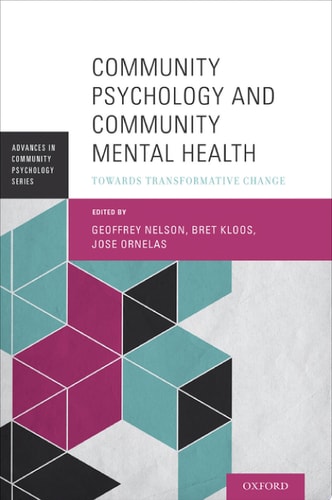
Community Psychology and Community Mental Health: Towards Transformative Change
Author Description
Mental health practices and programs around the world face growing criticism from policymakers, consumers, and service providers for being ineffective, overly reliant on treatment by professionals, and overly focused on symptoms. Many have called for new paradigms of mental health and new practices that can better support recovery, community integration, and adaptive functioning for persons diagnosed with psychiatric disabilities. While there has recently been much discourse about transformation and recovery, there has yet to be a critical and systematic review that unpacks the concept of mental health systems transformation or that examines strategies for how to create transformative change in mental health.Community Psychology and Community Mental Health provides empirical justification and a conceptual foundation for transformative change in mental health, based on community psychology values and principles of ecology, collaboration, empowerment, and social justice. Chapters provide strategies for making changes at the level of society, policy, organizations, community settings, and mental health practices. The editors and authors draw from experience in different countries in recognition of the need to tailor change strategies to different contexts. The common experiences of the international perspectives represented underscore the importance and the need for a new paradigm while demonstrating that there are many alternatives and opportunities for pursuing transformative change. This book will be of interest to community mental health professionals, researchers, and students, as well as policymakers, administrators, and those with lived experience of mental health issues.
Menrva's Summary
THE THESIS
This book investigates the systemic failures of current mental health practices and proposes a framework for transformative change rooted in the principles of community psychology. The authors, Bret Kloos, Geoffrey Brian Nelson, and José Ornelas, synthesize international research and empirical data to challenge the traditional, symptom-focused medical model. By advocating for a shift toward ecology, empowerment, and social justice, the text provides a structured approach for policymakers and practitioners to redesign mental health systems for better community integration.
THE SCOPE MAP
What You Will Find
- A critical review of current mental health system limitations and ineffective treatment paradigms.
- Strategies for implementing change across multiple levels, including societal, organizational, and policy frameworks.
- Comparative international case studies illustrating diverse approaches to mental health recovery.
- A foundational application of community psychology values such as collaboration and adaptive functioning.
THE AUTHORITY PERSPECTIVE
Experts identify this work as a comprehensive resource for those seeking to bridge the gap between theoretical community psychology and practical mental health administration. Readers frequently note the academic density of the prose, making it a foundational text for students and professionals in the field of social services.
Page Count:
432
Publication Date:
2014-09-10
Publisher:
Oxford University Press
ISBN-10:
0199362424
ISBN-13:
9780199362424
Psychology
Social Science
Mental Health
Public Policy
Sociology
Community Tags
Similar Books