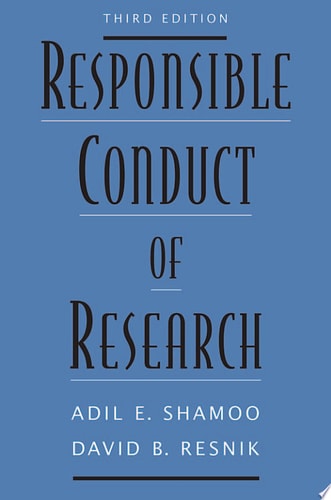
Responsible Conduct of Research
0
0
As an Amazon Associate and affiliate partner, Menrva Books earns from qualifying purchases. Learn more
Author Description
Since the early 2000s, the field of Responsible Conduct of Research has become widely recognized as essential to scientific education, investigation, and training. At present, research institutions with public funding are expected to have some minimal training and education in RCR for their graduate students, fellows and trainees. These institutions also are expected to have a system in place for investigating and reporting misconduct in research or violations of regulations in research with human subjects, or in their applications to federal agencies for funding. Public scrutiny of the conduct of scientific researchers remains high. Media reports of misconduct scandals, biased research, violations of human research ethics rules, and moral controversies in research occur on a weekly basis.Since the 2009 publication of the 2nd edition of Shamoo and Resnik's Responsible Conduct of Research, there has been a vast expansion in the information, knowledge, methods, and diagnosis of problems related to RCR and the multitude of ethical issues of human subject protections. With the climate surrounding research conduct always shifting, developments in the field make an updated edition a necessity. All chapters have been revised and reflect the most current RCR landscape. New or further-developed topics include social responsibility and misconduct in social sciences, climate-change research, authorship, and peer review. Updates include new information on research involving human subjects or "vulnerable" biological subjects, as well as genetic research. Just like in previous editions, all chapters contain recent case studies and legal examples of various subjects.
Menrva's Summary
THE THESIS
This text investigates the core question of how research institutions can maintain ethical integrity and regulatory compliance in an era of increasing public scrutiny. The authors, Adil E. Shamoo and David B. Resnik, leverage their extensive expertise in bioethics and scientific policy to provide a comprehensive framework for responsible conduct. By synthesizing current federal regulations, ethical standards, and institutional requirements, they argue that rigorous training and transparent reporting systems are necessary to mitigate misconduct and preserve the credibility of the scientific enterprise.
THE SCOPE MAP
What You Will Find
- Comprehensive analysis of federal regulations regarding research misconduct and human subject protections.
- Methodologies for implementing institutional training programs for graduate students and fellows.
- Case studies illustrating real-world ethical dilemmas in peer review, authorship, and social science research.
- Updated guidelines addressing contemporary challenges in climate change research and genetic studies.
THE AUTHORITY PERSPECTIVE
Experts recognize this work as a foundational text for academic institutions and research training programs. Readers frequently note the practical utility of the included case studies for navigating complex ethical landscapes in modern scientific practice.
Page Count:
360
Publication Date:
2015-01-02
Publisher:
Oxford University Press
ISBN-10:
0199376026
ISBN-13:
9780199376025
Science
Medicine
Ethics
Moral and ethical aspects
Professional Development
Reference
Scientists
Education
Medical Ethics
Bioethics
Community Tags
Similar Books