Author Description
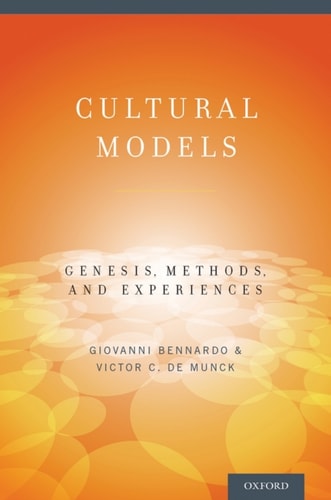
This book is about cultural models. Cultural models are defined as molar organizations of knowledge. Their internal structure consists of a 'core' component and 'peripheral' nodes that are filled by default values. These values are instantiated, i.e., changed to specific values or left at their default values, when the individual experiences 'events' of any type. Thus, the possibility arises for recognizing and categorizing events as representative of the same cultural model even if they slightly differ in each of their specific occurrences. Cultural models play an important role in the generation of one's behavior. They correlate well with those of others and the behaviors they help shape are usually interpreted by others as intended. A proposal is then advanced to consider cultural models as fundamental units of analysis for an approach to culture that goes beyond the dichotomy between the individual (culture only in mind) and the collective (culture only in the social realm). The genesis of the concept of cultural model is traced from Kant to contemporary scholars. The concept underwent a number of transformations (including label) while it crossed and received further and unique elaborations within disciplines like philosophy, psychology, anthropology, sociology, artificial intelligence, and cognitive science. A methodological trajectory is outlined that blends qualitative and quantitative techniques that cross-feed each other in the gargantuan effort to discover cultural models. A survey follows of the extensive research about cultural models carried out with populations of North Americans, Europeans, Latino- and Native-Americans, Asians (including South Asians and South-East Asians), Pacific Islanders, and Africans. The results of the survey generated the opportunity to propose an empirically motivated typology of cultural models rooted in the primary difference between foundational and molar types. The book closes with a suggestion of a number of avenues that
Menrva's Summary
THE THESIS
This book investigates the theoretical framework and methodological utility of cultural models as molar organizations of knowledge that bridge the gap between individual cognition and collective social behavior. Giovanni Bennardo and Victor de Munck synthesize historical, philosophical, and empirical research to argue that cultural models serve as the fundamental units of analysis for understanding how humans categorize events and generate behavior. By tracing the evolution of the concept from Kantian philosophy to modern cognitive science, the authors propose a unified approach that transcends the traditional dichotomy between the individual mind and the social realm.
THE SCOPE MAP
What You Will Find
- A historical trajectory of the cultural model concept across philosophy, psychology, anthropology, and artificial intelligence.
- A methodological framework integrating qualitative and quantitative techniques for the identification and analysis of cultural models.
- A comprehensive survey of cross-cultural research involving diverse populations, including North Americans, Europeans, Pacific Islanders, and Africans.
- An empirically motivated typology distinguishing between foundational and molar types of cultural models.
THE AUTHORITY PERSPECTIVE
Experts recognize this work as a significant synthesis of cognitive anthropology and social theory, providing a structured approach to a traditionally abstract field. Readers frequently note the academic density of the prose, which serves as a foundational text for researchers seeking to integrate cognitive models into their own social science investigations.
Page Count:
336
Publication Date:
2013-01-01
Publisher:
Oxford University Press
ISBN-10:
0199383936
ISBN-13:
9780199383931
Psychology
Sociology
Anthropology
Community Tags
Similar Books