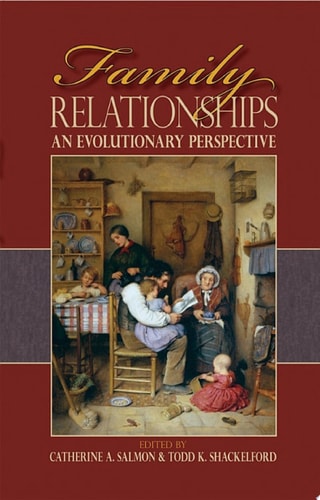
Family Relationships: An Evolutionary Perspective
0
0
As an Amazon Associate and affiliate partner, Menrva Books earns from qualifying purchases. Learn more
Author Description
Kinship ties-the close relationships found within the family-have been a central focus of evolutionary biological analyses of social behavior ever since biologist William Hamilton extended the concept of Darwinian fitness to include an individual's actions benefiting not only his own offspring, but also collateral kin. Evolutionary biologists consider organisms not only reproductive strategists, but also nepotistic strategists. If a person's genes are just as likely to be reproduced in her sister as in her daughter, then we should expect the evolution of sororal investment in the same way as one expects maternal investment. This concept has revolutionized biologists' understanding of social interaction and developmental psychologists' understanding of the family. However, kinship ties have largely been ignored in other areas of psychology, particularly social psychology.Family Relationships brings together leading theorists and researchers from evolutionary psychology and related disciplines to illustrate the ways in which an evolutionary perspective can inform our study and understanding of family relationships. The contributors argue that family psychology is relationship specific: the relationship between mother and daughter is different from that between father and daughter or that between brother and sister or sister and sister. In other words, humans have evolved specialized mechanisms for processing information and motivating behavior that deal with the distinct demands of being a mate, father, mother, sibling, child, or grandparent. Such an evolutionary perspective on family dynamics provides a unique insight into human behavior.This volume will be an indispensable resource for psychologists, sociologists, and anthropologists, as well scholars of family, marriage, and animal behavior.
Menrva's Summary
THE THESIS
This volume investigates how evolutionary biology and the concept of inclusive fitness can explain the development and maintenance of human family relationships. The authors, Catherine A. Salmon and Todd K. Shackelford, curate a collection of essays from leading researchers in evolutionary psychology to argue that human social behavior is shaped by specialized, evolved mechanisms. By applying Darwinian principles to kinship, the text posits that family dynamics are relationship-specific and driven by the distinct reproductive and survival demands of various familial roles.
THE SCOPE MAP
What You Will Find
- Theoretical frameworks regarding inclusive fitness and nepotistic strategies
- Analysis of specific familial roles including mates, parents, siblings, and grandparents
- Cross-disciplinary synthesis of evolutionary biology, developmental psychology, and social psychology
Scope Limits
- The text does not provide a comprehensive clinical guide for family therapy or counseling
- It does not focus on non-evolutionary sociological models of family structure
THE AUTHORITY PERSPECTIVE
Experts recognize this volume as a significant contribution to the integration of evolutionary theory within the broader field of family psychology. Readers frequently note the academic density of the prose, which serves as a specialized resource for scholars and researchers in the behavioral sciences.
Page Count:
376
Publication Date:
2007-01-01
Publisher:
Oxford University Press
ISBN-10:
0190295686
ISBN-13:
9780190295684
Psychology
General Anthropology
Sociology
Anthropology
Evolutionary Psychology
Social Science
Family Studies
Community Tags
Similar Books