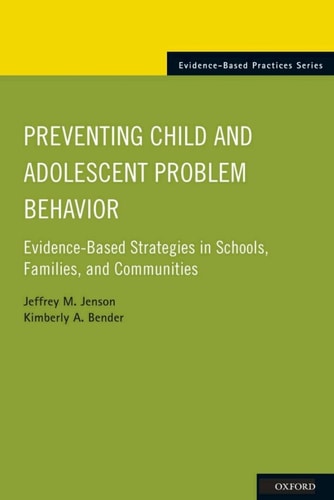
Preventing Child and Adolescent Problem Behavior: Evidence-Based Strategies in Schools, Families, and Communities
0
0
As an Amazon Associate and affiliate partner, Menrva Books earns from qualifying purchases. Learn more
Author Description
Children and youth face enormous developmental challenges in American society. At no time in the country's history have young people been confronted simultaneously by such a wide array of positive and negative influences and opportunities. Fortunately, most adolescents become healthy adults who participate in positive life activities. For some young people, however, the path to successful adulthood is characterized by involvement in problem behaviors like substance abuse, delinquency, violence, or school dropout. Prevention has been heralded as an effective way to reduce the adverse effects associated with childhood and adolescent problem behavior. Bolstered by evidence indicating that empirically-based programs can prevent or delay the onset of child and adolescent problems, many schools and communities have strengthened their commitment to prevention programming. Yet efforts to identify and disseminate evidence-based school, family, and community prevention strategies are lacking. In this book, we trace the rationale, history, and evolution of prevention in the United States. Empirical evidence pertaining to the prevention of common child and adolescent problems is identified and systematically reviewed. A public health framework based on concepts of risk and protection is used as a theoretical guide to inform our review and discussion. Common characteristics of evidence-based prevention programs are identified. Program Implementation, fidelity, and adaptation challenges are discussed. Practice, policy, and educational recommendations aimed at advancing prevention are noted.
Menrva's Summary
THE THESIS
This book investigates the efficacy of evidence-based prevention strategies designed to mitigate problem behaviors in children and adolescents across school, family, and community settings. Jeffrey M. Jenson and Kimberly A. Bender, both established scholars in social work and youth development, utilize a public health framework to analyze the intersection of risk factors and protective mechanisms. By systematically reviewing empirical data, the authors provide a comprehensive evaluation of current prevention programming and offer actionable recommendations for policy and practice.
THE SCOPE MAP
What You Will Find
- A historical overview of the evolution of prevention programming in the United States.
- A systematic review of empirical evidence regarding substance abuse, delinquency, violence, and school dropout.
- Analysis of program implementation, fidelity, and the challenges of adapting models to diverse environments.
- A public health framework centered on risk and protection concepts to guide intervention strategies.
THE AUTHORITY PERSPECTIVE
Experts in the fields of social work and education frequently cite this text as a foundational resource for understanding the mechanics of evidence-based prevention. Readers often note the academic density of the prose, which serves as a rigorous guide for practitioners and policymakers seeking to implement effective youth interventions.
Page Count:
208
Publication Date:
2013-01-01
Publisher:
Oxford University Press
ISBN-10:
0199383944
ISBN-13:
9780199383948
Politics
Psychology
Categories
Sociology
Kindle eBooks
Education
Medicine
Social Work
Public Health
Kindle Store
Community Tags
Similar Books