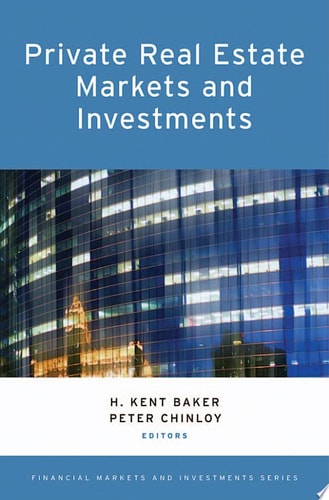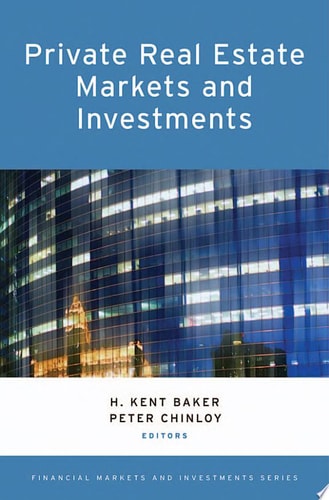
Private Real Estate Markets and Investments
0
0
As an Amazon Associate and affiliate partner, Menrva Books earns from qualifying purchases. Learn more
Author Description
This book provides an overview of private real estate markets and investments. The 14 chapters are divided into three sections for conventional and alternative real estate investments and regulatory issues. Conventional investable real assets examined are retail spaces, apartments, offices, and industrial facilities owned by corporate entities. Alternative real estate assets are uniquely and extensively addressed. These include healthcare, both for facilities and the pricing to make it an investable asset; infrastructure contains roads, bridges, and public utilities; and resources are in land, agriculture, oil, and gas. The regulatory section includes appraisal and valuation, brokerage and transaction costs, sustainability, and green buildings. Readers should gain a greater appreciation of what is needed to be successful when investing in private real estate markets.The share of real estate in institutional portfolios has risen above a previous 5% target, as investors avoid the risks of low interest rates. The world's wealth is shifting to emerging markets where real estate is already a dominant asset class and public securities markets are limited. Institutions with long horizons avoid publicly traded markets because they want to capture any premium from illiquidity. Real estate involves local and cultural restrictions on land usage, sustainability and on the regulation of the illiquidity.For information about public real estate, read Public Real Estate Markets and Investments.
Menrva's Summary
THE THESIS
This book investigates the mechanics, valuation, and regulatory frameworks governing private real estate markets as a distinct asset class for institutional investors. H. Kent Baker and Peter Chinloy utilize their extensive academic and professional expertise to synthesize complex market data into a structured guide. The authors argue that as institutional portfolios shift away from low-interest-rate environments, private real estate offers a necessary premium for long-term investors, provided they navigate the specific local, cultural, and regulatory constraints inherent to land usage.
THE SCOPE MAP
What You Will Find
- Analysis of conventional assets including retail, office, apartment, and industrial properties.
- Examination of alternative real estate sectors such as healthcare facilities, infrastructure, and natural resources.
- Methodologies for appraisal, valuation, and managing transaction costs.
- Discussion on the impact of sustainability and green building standards on investment viability.
THE AUTHORITY PERSPECTIVE
Experts identify this text as a comprehensive resource for understanding the transition of institutional capital into private real estate markets. Readers frequently note the academic rigor and the clear, structured approach the authors take toward explaining both traditional and alternative asset classes.
Page Count:
471
Publication Date:
2014-01-01
Publisher:
Oxford University Press
ISBN-10:
0199388776
ISBN-13:
9780199388776
Business
Economics
Professional Career & Trade
Finance
Investment
Real Estate