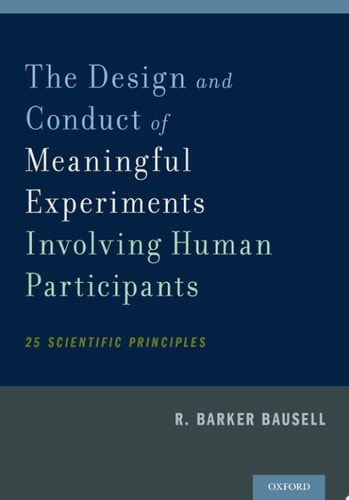
Design and Conduct of Meaningful Experiments Involving Human Participants: 25 Scientific Principles
0
0
As an Amazon Associate and affiliate partner, Menrva Books earns from qualifying purchases. Learn more
Author Description
Designing And Conducting Experiments Involving Human Participants Requires A Skillset Different From That Needed For Statistically Analyzing The Resulting Data. The Design And Conduct Of Meaningful Experiments Involving Human Participants Combines An Introduction To Scientific Culture And Ethical Mores With Specific Experimental Design And Procedural Content. Author R. Barker Bausell Assumes No Statistical Background On The Part Of The Reader, Resulting In A Highly Accessible Text. Clear Instructions Are Provided On Topics Ranging From The Selection Of A Societally Important Outcome Variable To Potentially Efficacious Interventions To The Conduct Of The Experiment Itself. Early Chapters Introduce The Concept Of Experimental Design In An Intuitive Manner Involving Both Hypothetical And Real-life Examples Of How People Make Causal Inferences. The Fundamentals Of Formal Experimentation, Randomization, And The Use Of Control Groups Are Introduced In The Same Manner, Followed By The Presentation And Explanation Of Common (and Later, More Advanced) Designs. Replete With Synopses Of Examples From The Journal Literature And Supplemented By 25 Experimental Principles, This Book Is Designed To Serve As An Interdisciplinary Supplementary Text For Research-methods Courses In The Educational, Psychological, Behavioral, Social, And Health Sciences. It Also Serves As An Excellent Primary Text For Methods Seminar Courses.
Menrva's Summary
THE THESIS
How can researchers effectively design and conduct experiments involving human participants while maintaining ethical standards and scientific rigor? Author R. Barker Bausell provides a comprehensive framework for experimental design that prioritizes procedural integrity and ethical considerations over complex statistical analysis. By focusing on the logic of causal inference, the text guides readers through the selection of outcome variables and the implementation of interventions without requiring prior mathematical expertise.
THE SCOPE MAP
What You Will Find
- A foundational introduction to scientific culture and ethical research mores.
- Practical guidance on selecting societally important outcome variables and interventions.
- Detailed explanations of randomization, control groups, and formal experimental structures.
- A collection of 25 core scientific principles applied to real-world and hypothetical research scenarios.
THE AUTHORITY PERSPECTIVE
Experts and educators frequently cite this work as a highly accessible resource for students in the behavioral and social sciences who lack a deep statistical background. The text is widely utilized in research-methods courses as a foundational guide for understanding the logic behind experimental design.
Page Count:
288
Publication Date:
2014-01-01
Publisher:
Oxford University Press, Incorporated
ISBN-10:
0199385246
ISBN-13:
9780199385249
Science
Psychology
Research Methods
Education
Psychology
Community Tags
Similar Books