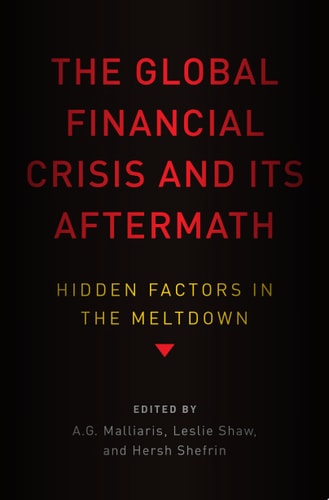
The Global Financial Crisis and Its Aftermath
0
0
As an Amazon Associate and affiliate partner, Menrva Books earns from qualifying purchases. Learn more
Author Description
In The Global Financial Crisis, Contributors Argue That The Complexity Of The Global Financial Crisis Challenges Researchers To Offer More Comprehensive Explanations By Extending The Scope And Range Of Their Traditional Investigations. To Achieve This, The Volume Views The Financial Crisis Simultaneously Through Three Different Lenses---economic, Psychological, And Social Values. Contributors Offer A Constructive Methodology Suitable For Exploring Financial Crises. They Recognize How Current Economic Analysis Did Not Prepare Academic Economists, Business Economists, Traders, And Regulators To Anticipate Economic And Financial Crises. So, They Search More Extensively Within The Broader Discipline Of Economics For Ideas Related To Crises But Neglected Perhaps Because They Were Not Mathematically Rigorous. They Affirm That The Complexity Of Financial Crises Necessitates Complementary Research. Thus, To Put The Focal Purpose Of This Book Differently, They Explore The Global Financial Crisis From Three Interconnected Frameworks: The Standards Of Orthodox Economic Analysis, Minskyan Economics, And The Role Of Ideas And Values In Economics. Values Are The Subject Of Both Philosophy And Psychology And Can Contribute To A Better Understanding Of The Global Financial Crisis. Values, In General, Have Been Relatively Neglected By Economists. This Is Not Because There Is Doubt About Their Significance, But Rather Because Welfare Economics And Collective Choice Still Operate Within The Neoclassical Paradigm. This Volume Argues That Analyzing The Value Implications Requires Moving From The Neoclassical Framework To Something That Is Broader And Multidisciplinary.
Menrva's Summary
THE THESIS
This volume investigates the limitations of traditional economic models in predicting financial instability and proposes a multidisciplinary framework to better understand the global financial crisis. The authors, A. G. Malliaris, Hersh Shefrin, and Leslie Shaw, synthesize perspectives from economics, psychology, and social philosophy to address why standard neoclassical analysis failed to anticipate the 2008 collapse. By integrating Minskyan theory with behavioral insights and value-based analysis, the text argues for a broader, more inclusive methodology that accounts for human behavior and societal norms in financial systems.
THE SCOPE MAP
What You Will Find
- A comparative analysis of neoclassical economic paradigms versus Minskyan financial instability theory.
- Methodological frameworks for integrating psychological and philosophical values into economic research.
- Critical evaluations of the failure of regulators and traders to anticipate systemic market risks.
- A multidisciplinary approach to welfare economics and collective choice theory.
THE AUTHORITY PERSPECTIVE
Experts identify this work as a significant contribution to the post-crisis discourse, particularly for its attempt to bridge the gap between quantitative economics and qualitative social values. Readers frequently note the academic density of the prose, which serves as a rigorous resource for economists and policy researchers seeking to expand their analytical toolkit.
Page Count:
400
Publication Date:
2016-01-01
Publisher:
Oxford University Press
ISBN-10:
0199386242
ISBN-13:
9780199386246
Philosophy
Economics
Finance
Social Science
Community Tags
Similar Books