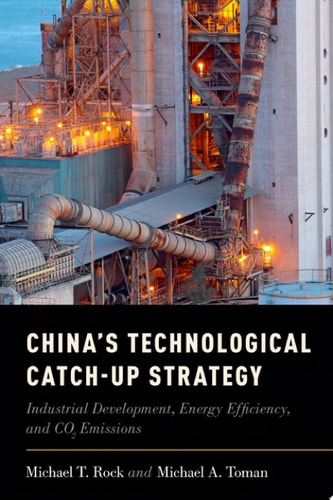
China's Technological Catch-Up Strategy: Industrial Development, Energy Efficiency, and CO2 Emissions
0
0
As an Amazon Associate and affiliate partner, Menrva Books earns from qualifying purchases. Learn more
Author Description
Prior to 1979, China had a bifurcated and geographically-dispersed industrial structure made up of a relatively small number of large-scale, state-owned enterprises in various industries alongside numerous small-scale, energy-intensive and polluting enterprises. Economic reforms beginning in 1979 led to the rapid expansion of these small-scale manufacturing enterprises in numerous energy-intensive industries such as aluminum, cement, iron and steel, and pulp and paper. Subsequently, the government adopted a new industrial development strategy labeled "grasp the large, let go the small." The aims of this new policy were to close many of the unprofitable, small-scale manufacturing plants in these (and other) industries, create a small number of large enterprises that could compete with OECD multinationals, entice these larger enterprises to engage in high-speed technological catch-up, and save energy.China's Technological Catch-Up Strategy traces the impact of this new industrial development strategy on technological catch-up, energy use, and CO2 emissions. In doing so, the authors explore several detailed, enterprise-level case studies of technological catch-up; develop industry-wide estimates of energy and CO2 savings from specific catch-up interventions; and present detailed econometric work on the determinants of energy intensity. The authors conclude that China's strategy has contributred to substantial energy and CO2 savings, but it has not led to either a peaking of or a decline in CO2 emissions in these industries. More work is needed to cap and reduce China's CO2 emissions.
Menrva's Summary
THE THESIS
This book investigates the efficacy of China's industrial development strategy in balancing rapid economic growth with the urgent need for energy efficiency and carbon emission reduction. The authors, Michael A. Toman and Michael T. Rock, utilize a combination of enterprise-level case studies and econometric modeling to evaluate the "grasp the large, let go the small" policy. By analyzing the transition from small-scale, polluting manufacturing to large-scale, competitive enterprises, the text provides a rigorous assessment of whether technological catch-up can successfully decouple industrial expansion from environmental degradation.
THE SCOPE MAP
What You Will Find
- Analysis of the "grasp the large, let go the small" industrial policy framework.
- Enterprise-level case studies focusing on aluminum, cement, iron, steel, and pulp and paper industries.
- Econometric modeling regarding the determinants of energy intensity in Chinese manufacturing.
- Quantitative estimates of energy and CO2 savings resulting from specific technological interventions.
THE AUTHORITY PERSPECTIVE
Experts recognize this work as a critical, data-driven examination of the intersection between Chinese industrial policy and climate change mitigation. Readers frequently note the technical density of the econometric analysis, making it a valuable resource for policy analysts and researchers focused on sustainable development.
Page Count:
292
Publication Date:
2015-03-09
Publisher:
Oxford University Press
ISBN-10:
0199385327
ISBN-13:
9780199385324
Economics
Industries china
Public Policy
Industries
Energy policy
Technology and state
Industrial Policy
China
Community Tags
Similar Books