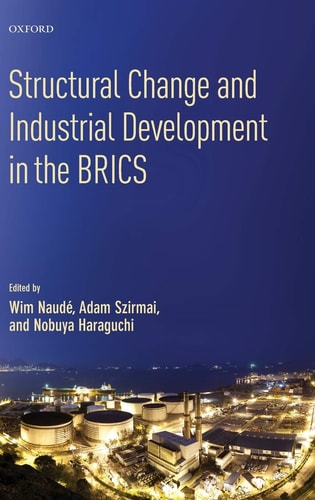
Structural Change and Industrial Development in the BRICS
0
0
As an Amazon Associate and affiliate partner, Menrva Books earns from qualifying purchases. Learn more
Author Description
This book provides a unique and timely analysis of the role of structural change in the economic development of Brazil, Russia, India, China, and South Africa (BRICS) with a consideration for the role of industry, and in particular manufacturing. The emergence of BRICS reflects an ongoing change in the international economic order. BRICS now account for very substantial part of global GDP, global manufactured value added and global manufactured exports. The book examines their economic experiences and structural change in BRICS over the past three decades, identifying both differences and commonalities, and deriving lessons for other industrializing countries.Section I contains comparative studies focusing on the commonalities and differences of the experiences of BRICS. Section II includes six country studies providing a more detailed analysis of the long-run experiences of each of the countries. Section III consists of a set of seven thematic studies focusing on specific topics such as global value chains, the role of transnational corporations in the food chain, the role of foreign versus domestic investment, the role of domestic versus foreign demand in economic growth the diffusion of environmental energy technology and the similarities, and the differences in industrial policies pursued in the five countries. The book contains a summary chapter that provides an integrated perspective of the various contributions from the point of view of poverty reduction and development. It asks, whether the patterns of structural change and industrial development that BRICS experienced, had an impact on poverty outcomes, and if so, what where the channels and the consequences?
Menrva's Summary
THE THESIS
This book investigates how structural economic shifts and industrial development, particularly within the manufacturing sector, have influenced the growth trajectories and poverty reduction outcomes of the BRICS nations. The authors, Adam Szirmai, Nobuya Haraguchi, and Wim Naude, utilize a multi-faceted analytical framework to synthesize three decades of economic data from Brazil, Russia, India, China, and South Africa. By comparing these diverse national experiences, the text evaluates the effectiveness of various industrial policies and the integration of these nations into the global economic order.
THE SCOPE MAP
What You Will Find
- Comparative analysis of industrial development patterns across the five BRICS nations.
- Detailed country-specific case studies examining long-run economic evolution.
- Thematic investigations into global value chains, foreign investment, and environmental technology diffusion.
- Evaluation of the causal links between industrial structural change and poverty reduction outcomes.
THE AUTHORITY PERSPECTIVE
Experts identify this work as a comprehensive reference for understanding the industrialization strategies of emerging economies. Readers frequently note the academic density of the prose and the rigorous empirical approach taken by the contributors to analyze complex macroeconomic trends.
Page Count:
572
Publication Date:
2015-08-15
Publisher:
Oxford University Press
ISBN-10:
0198725078
ISBN-13:
9780198725077
Economics
China
Industrial Policy
India
International relations
Developing Countries
Global Studies
Community Tags
Similar Books