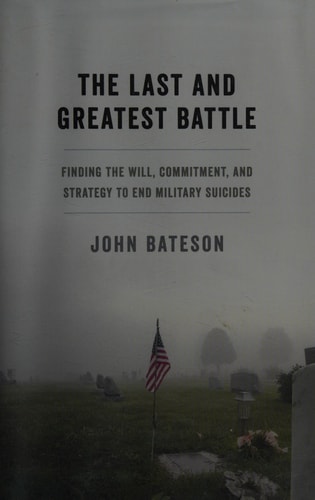
The Last and Greatest Battle: Finding the Will, Commitment, and Strategy to End Military Suicides
0
0
As an Amazon Associate and affiliate partner, Menrva Books earns from qualifying purchases. Learn more
Author Description
Nearly every day an active-duty soldier in the United States military resorts to suicide, and nearly every hour a veteran does the same. In recent years the problem of military suicides has reached epidemic proportions, but it's all too easy for most of us to gloss over the headlines or tune out the details.In The Last and Greatest Battle--the first book devoted exclusively to the problem of military suicides--John Bateson brings this neglected crisis into the spotlight. Bateson, the former executive director of a nationally certified suicide prevention center, surveys the history of suicide in the United States military from the Civil War to the present day and outlines a plan to save lives-and ultimately end the tragedy of military suicides.He uses the stories of individual soldiers to illuminate the unique challenges faced by American troops today. Transitioning from the front lines to the home front is difficult for many service members, and many need help both during and after their deployments. But even though the military is spending millions of dollars on suicide prevention programs, record numbers of soldiers continue to take their lives.To that end, Bateson outlines a plan of action. If the military works to remove stigma, to make treatment more effective and more accessible, and to limit risk factors for suicide in the first place by taking measures like reducing the number and length of deployments and adjusting pre-deployment training to take into account the way that wars are waged today, an end to the problem of military suicide is as possible as it is essential.
Menrva's Summary
THE THESIS
This book investigates the escalating crisis of suicide among active-duty military personnel and veterans, questioning why current prevention programs fail to curb the rising death toll. John Bateson, a former executive director of a suicide prevention center, utilizes historical analysis and individual case studies to examine the systemic factors contributing to this epidemic. He argues that the military must move beyond existing protocols to implement structural changes in deployment cycles, training, and the cultural stigma surrounding mental health care.
THE SCOPE MAP
What You Will Find
- Historical overview of suicide rates in the U.S. military from the Civil War to the modern era.
- Analysis of the psychological challenges inherent in transitioning from combat zones to civilian life.
- Evaluation of current military-funded suicide prevention programs and their efficacy.
- Proposed strategic framework for reducing risk factors, including deployment length and pre-deployment training adjustments.
THE AUTHORITY PERSPECTIVE
Experts and readers recognize this work as a significant contribution to the discourse on military mental health, noting its blend of historical context and actionable policy recommendations. The text is frequently cited for its clear, accessible prose that balances clinical insight with the personal narratives of service members.
Page Count:
384
Publication Date:
2015-01-30
Publisher:
Oxford University Press
ISBN-10:
0199392323
ISBN-13:
9780199392322
Psychology
History
Non-Fiction
Military
Public Health
Social Science
Suicide
Mental Illness
Combat
Veterans
Soldiers
Community Tags
Similar Books