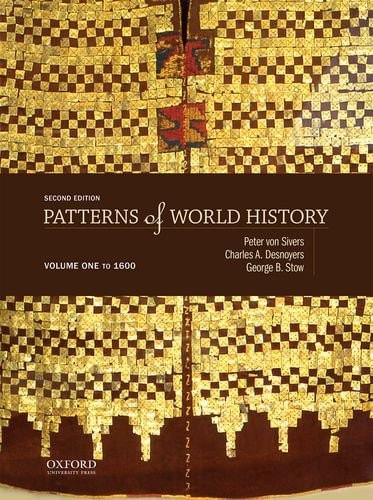
Patterns of World History: Volume One: To 1600
0
0
As an Amazon Associate and affiliate partner, Menrva Books earns from qualifying purchases. Learn more
Author Description
Encouraging a broad-based understanding of continuity, change, and innovation in human history, Patterns of World History presents the global past in a comprehensive, even-handed, and open-ended fashionPatterns of World History offers a distinct framework for understanding the global past through the study of origins, interactions, and adaptations. Authors Peter von Sivers, Charles A. Desnoyers, and George Stow--each specialists in their respective fields--examine the full range of human ingenuity over time and space in a comprehensive, even-handed, and critical fashion.The book helps students to see and understand patterns through: ORIGINS - INTERACTIONS - ADAPTATIONSThese key features show the O-I-A framework in action:* Seeing Patterns, a list of key questions at the beginning of each chapter, focuses students on the 3-5 over-arching patterns, which are revisited, considered, and synthesized at the end of the chapter in Thinking Through Patterns* Each chapter includes a Patterns Up Close case study that brings into sharp relief the O-I-A pattern using a specific idea or thing that has developed in human history (and helped, in turn, develop human history), like the innovation of the Chinese writing system or religious syncretism in India. Each case study clearly shows how an innovation originated either in one geographical center or independently in several different centers. It demonstrates how, as people in the centers interacted with their neighbors, the neighbors adapted to--and in many cases were transformed by--the idea, object, or event. Adaptations include the entire spectrum of human responses, ranging from outright rejection to creative borrowing and, at times, forced acceptance.
Menrva's Summary
THE THESIS
This volume investigates the core question of how human history can be understood through the recurring patterns of origins, interactions, and adaptations. The authors, all established specialists in their respective historical fields, utilize this O-I-A framework to organize the vast complexities of the global past into a manageable and analytical structure. By focusing on how innovations emerge, spread, and are modified by different societies, the text provides a systematic method for students to synthesize historical data across time and space.
THE SCOPE MAP
What You Will Find
- A comprehensive survey of human history from early origins through the year 1600.
- The O-I-A (Origins, Interactions, Adaptations) analytical framework applied to global historical developments.
- Patterns Up Close case studies that examine specific innovations like writing systems and religious syncretism.
- Thinking Through Patterns synthesis exercises designed to reinforce critical thinking and thematic connections.
THE AUTHORITY PERSPECTIVE
Educators frequently utilize this text as a foundational resource for undergraduate world history courses due to its structured approach to complex historical narratives. Experts highlight the O-I-A framework as a useful pedagogical tool for helping students move beyond rote memorization toward a more conceptual understanding of historical change.
Page Count:
648
Publication Date:
2014-10-28
Publisher:
Oxford University Press
ISBN-10:
019939962X
ISBN-13:
9780199399628
History
Academic
World history
textbook
Community Tags
Other Editions(2)
Similar Books









Reader Comments
Share Your Thoughts
No comments yet. Be the first to share your thoughts!