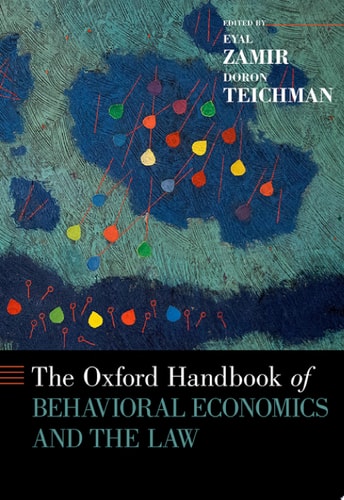
The Oxford Handbook of Behavioral Economics and the Law (Oxford Handbooks)
0
0
As an Amazon Associate and affiliate partner, Menrva Books earns from qualifying purchases. Learn more
Author Description
The past twenty years have witnessed a surge in behavioral studies of law and law-related issues. These studies have challenged the application of the rational-choice model to legal analysis and introduced a more accurate and empirically grounded model of human behavior. This integration of economics, psychology, and law is breaking exciting new ground in legal theory and the social sciences, shedding a new light on age-old legal questions as well as cutting edge policy issues.The Oxford Handbook of Behavioral Economics and Law brings together leading scholars of law, psychology, and economics to provide an up-to-date and comprehensive analysis of this field of research, including its strengths and limitations as well as a forecast of its future development. Its 29 chapters organized in four parts. The first part provides a general overview of behavioral economics. The second part comprises four chapters introducing and criticizing the contribution of behavioral economics to legal theory. The third part discusses specific behavioral phenomena, their ramifications for legal policymaking, and their reflection in extant law. Finally, the fourth part analyzes the contribution of behavioral economics to fifteen legal spheres ranging from core doctrinal areas such as contracts, torts and property to areas such as taxation and antitrust policy.
Menrva's Summary
THE THESIS
This volume investigates the intersection of behavioral economics and legal theory to determine how empirically grounded models of human behavior can improve legal analysis and policymaking. Editors Doron Teichman and Eyal Zamir, both distinguished scholars in law and economics, curate a collection of essays that evaluate the limitations of the traditional rational-choice model. By synthesizing insights from psychology and economics, the contributors provide a rigorous framework for assessing how cognitive biases and behavioral patterns influence legal doctrines and regulatory outcomes.
THE SCOPE MAP
What You Will Find
- A comprehensive overview of behavioral economics principles applied to legal systems.
- Critical analysis of the integration between behavioral science and traditional legal theory.
- Examination of specific behavioral phenomena and their direct impact on legal policymaking.
- Detailed case studies across fifteen legal domains, including contracts, torts, property, taxation, and antitrust policy.
THE AUTHORITY PERSPECTIVE
Experts and legal scholars identify this handbook as a foundational reference for understanding the current state of behavioral law and economics. Readers frequently note the academic density of the prose, which serves as a comprehensive resource for researchers and practitioners navigating the intersection of these disciplines.
Page Count:
840
Publication Date:
2014-01-01
Publisher:
Oxford University Press
ISBN-10:
0199397953
ISBN-13:
9780199397952
Economics
Psychology
Economics
Professional Career & Trade
Legal Theory
Law
Behavioral Science
Public Policy
Macroeconomic Theory
Community Tags
Similar Books