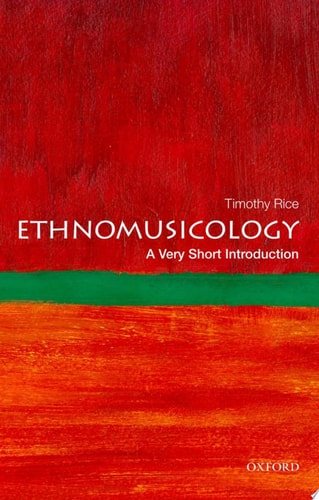
Ethnomusicology: A Very Short Introduction
0
0
As an Amazon Associate and affiliate partner, Menrva Books earns from qualifying purchases. Learn more
Author Description
Ethnomusicologists believe that all humans, not just those we call musicians, are musical, and that musicality is one of the essential touchstones of the human experience. This insight raises big questions about the nature of music and the nature of humankind, and ethnomusicologists argue that to properly address these questions, we must study music in all its geographical and historical diversity.In this Very Short Introduction, one of the foremost ethnomusicologists, Timothy Rice, offers a compact and illuminating account of this growing discipline, showing how modern researchers go about studying music from around the world, looking for insights into both music and humanity. The reader discovers that ethnomusicologists today not only examine traditional forms of music-such as Japanese gagaku, Bulgarian folk music, Javanese gamelan, or Native American drumming and singing-but also explore more contemporary musical forms, from rap and reggae to Tex-Mex, Serbian turbofolk, and even the piped-in music at the Mall of America. To investigate these diverse musical forms, Rice shows, ethnomusicologists typically live in a community, participate in and observe and record musical events, interview the musicians, their patrons, and the audience, and learn to sing, play, and dance. It's important to establish rapport with musicians and community members, and obtain the permission of those they will work with closely over the course of many months and years. We see how the researcher analyzes the data to understand how a particular musical tradition works, what is distinctive about it, and how it bears the personal, social, and cultural meanings attributed to it. Rice also discusses how researchers may apply theories from anthropology and other social sciences, to shed further light on the nature of music as a human behavior and cultural practice. About the Series:Oxford's Very Short Introductions series offers concise and original introductions to a wide range of subjects.
Menrva's Summary
THE THESIS
This book investigates the core question of how music functions as a universal human behavior and what the study of global musical traditions reveals about the nature of humanity. Timothy Rice, a prominent scholar in the field, utilizes his extensive academic background to synthesize the methodologies and theoretical frameworks that define modern ethnomusicology. He argues that by examining music within its specific geographical and historical contexts, researchers can uncover the complex social, cultural, and personal meanings embedded in diverse musical practices.
THE SCOPE MAP
What You Will Find
- An overview of the historical development and current research practices within the discipline of ethnomusicology.
- Methodologies for fieldwork, including participant observation, interviewing, and the acquisition of performance skills.
- Case studies ranging from traditional forms like Japanese gagaku and Javanese gamelan to contemporary genres such as rap and commercial mall music.
- Theoretical applications derived from anthropology and social sciences to interpret music as a cultural practice.
THE AUTHORITY PERSPECTIVE
Experts and students frequently cite this text as a foundational, accessible entry point for understanding the breadth of ethnomusicological inquiry. Readers note that the prose is concise and effectively balances academic rigor with clear explanations of complex cultural theories.
Page Count:
168
Publication Date:
2013-01-01
Publisher:
Oxford University Press
ISBN-10:
0199397546
ISBN-13:
9780199397549
Music
Social Science
Humanities
Anthropology
Community Tags
Other Editions(2)
Similar Books








Reader Comments
Share Your Thoughts
No comments yet. Be the first to share your thoughts!