Denying to the Grave: Why We Ignore the Facts That Will Save Us
0
0
As an Amazon Associate and affiliate partner, Menrva Books earns from qualifying purchases. Learn more
Author Description
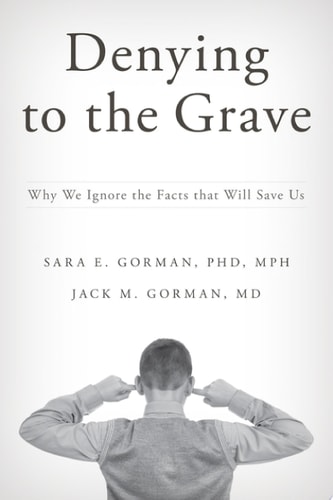
Why do some parents refuse to vaccinate their children? Why do some people keep guns at home, despite scientific evidence of risk to their family members? And why do people use antibiotics for illnesses they cannot possibly alleviate? When it comes to health, many people insist that science is wrong, that the evidence is incomplete, and that unidentified hazards lurk everywhere. In Denying to the Grave, Gorman and Gorman, a father-daughter team, explore the psychology of health science denial. Using several examples of such denial as test cases, they propose six key principles that may lead individuals to reject "accepted" health-related wisdom: the charismatic leader; fear of complexity; confirmation bias and the internet; fear of corporate and government conspiracies; causality and filling the ignorance gap; and the nature of risk prediction. The authors argue that the health sciences are especially vulnerable to our innate resistance to integrate new concepts with pre-existing beliefs. This psychological difficulty of incorporating new information is on the cutting edge of neuroscience research, as scientists continue to identify brain responses to new information that reveal deep-seated, innate discomfort with changing our minds. Denying to the Grave explores risk theory and how people make decisions about what is best for them and their loved ones, in an effort to better understand how people think when faced with significant health decisions. This book points the way to a new and important understanding of how science should be conveyed to the public in order to save lives with existing knowledge and technology.
Menrva's Summary
THE THESIS
This book investigates the psychological mechanisms that cause individuals to reject established scientific evidence regarding personal and public health. The authors, a father-daughter team consisting of a psychiatrist and a public health expert, synthesize findings from neuroscience and behavioral psychology to explain why human cognitive biases often override empirical data. They argue that the brain is biologically predisposed to resist information that conflicts with pre-existing beliefs, a tendency that becomes particularly dangerous when applied to medical decision-making and risk assessment.
THE SCOPE MAP
What You Will Find
- Analysis of six psychological principles driving health science denial, including confirmation bias and fear of complexity.
- Examination of high-stakes case studies such as vaccine hesitancy and antibiotic misuse.
- Integration of current neuroscience research regarding brain responses to contradictory information.
- Proposed strategies for improving public health communication to better align with human cognitive patterns.
THE AUTHORITY PERSPECTIVE
Experts and readers frequently cite this work as a clear, accessible entry point into the intersection of cognitive science and public health policy. The text is noted for its balanced approach to complex neurological concepts, making it a useful resource for both laypeople and professionals interested in behavioral science.
Page Count:
324
Publication Date:
2016-01-01
Publisher:
Oxford University Press
ISBN-10:
0199396620
ISBN-13:
9780199396627
Non-Fiction
Science
Psychology
Health
Science
Skepticism
Allied Health
Sociology
Sociology of Death
Medical
Community Tags
Similar Books