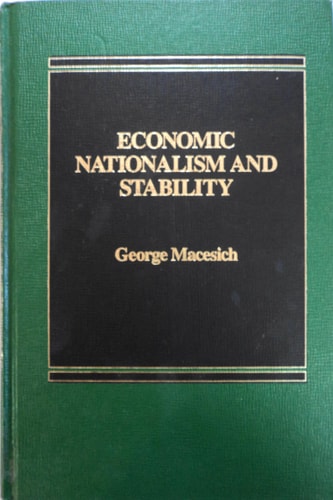
Economic nationalism and stability
0
0
As an Amazon Associate and affiliate partner, Menrva Books earns from qualifying purchases. Learn more
Author Description
This study examines concepts of nationalism as they effect stability in general, particularly economic stability, in Third World nations. Macesich discusses how emerging nations use economic nationalism as an integrative force to accelerate economic development. He shows how growing world interdependence makes such policies a major cause of monetary instability. In view of the dangerous side effects of economic nationalism, the author recommends a cosmopolitan alternative, with a system of well-defined guidelines within lawful policy systems that constrain bureaucracies and elites from the discretionary exercise of power especially in the monetary and financial areas.
Menrva's Summary
THE THESIS
This study investigates the relationship between economic nationalism and the maintenance of monetary and financial stability in developing nations. George Macesich, an economist specializing in monetary theory and international systems, utilizes historical and comparative economic data to analyze how emerging states employ nationalist policies to drive development. He argues that while these policies serve as an integrative force, they simultaneously generate significant monetary instability due to the realities of global economic interdependence.
THE SCOPE MAP
What You Will Find
- Analysis of economic nationalism as a tool for national integration
- Examination of the conflict between domestic development policies and global financial interdependence
- Proposed framework for a cosmopolitan alternative to nationalist economic policy
- Guidelines for constraining bureaucratic and elite discretionary power
Scope Limits
- Does not provide a comprehensive history of all Third World economic systems
- Does not offer specific country-by-country case studies of every developing nation
THE AUTHORITY PERSPECTIVE
Experts recognize this work as a focused contribution to the discourse on international monetary policy and the political economy of development. Readers frequently note the academic density of the prose and the author's emphasis on institutional constraints as a primary mechanism for stability.
Page Count:
163
Publication Date:
1985-01-01
Publisher:
Praeger
ISBN-10:
0030057485
ISBN-13:
9780030057489
Economics
Economics
Medical Books
Macroeconomics
Psychology
International relations